
Business | Public Interest
Nigeria Records ₦12.59tn Trade Surplus in Q2 2026 as Exports Surge
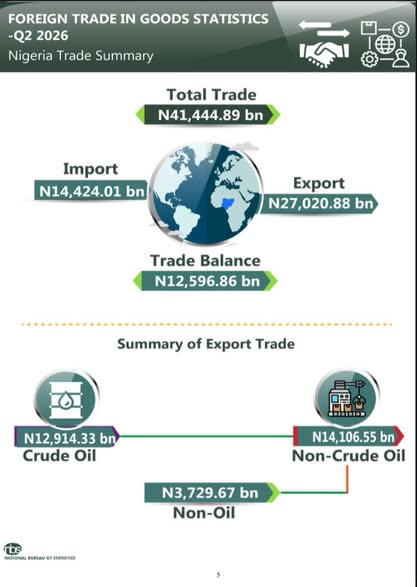
Nigeria recorded a ₦12.59 trillion merchandise trade surplus in the second quarter of 2026, as the value of goods exported significantly exceeded the country's imports during the period. Data from the National Bureau of Statistics (NBS) showed that Nigeria's total merchandise trade rose strongly in the quarter, with exports growing faster than imports. The reported trade surplus represents an increase of about 66.85 per cent compared with the previous quarter. A trade surplus occurs when a country's exports are worth more than its imports. In Nigeria's case, the latest figures indicate stronger export performance and a comparatively lower value of imported goods during the quarter. Reports on the NBS figures put Nigeria's total merchandise trade in Q2 at approximately ₦41.44 trillion, while imports were valued at about ₦14.4 trillion, resulting in the ₦12.59 trillion surplus. Export Performance Drives Improvement The latest data point to exports as the major driver of the improvement in Nigeria's external trade position. The development is particularly significant for an economy that has historically relied heavily on crude oil and petroleum-related exports to generate foreign exchange. A stronger trade balance can potentially support foreign-exchange liquidity and strengthen the country's external position. However, a trade surplus alone does not necessarily mean that households and businesses will immediately experience lower prices or improved living standards. The composition of exports, the stability of global commodity prices, domestic production capacity and the country's ability to convert export earnings into broader economic growth remain important factors. What the Figures Mean for Nigeria The Q2 performance comes as the Federal Government continues to implement economic reforms aimed at strengthening exports, attracting investment and improving Nigeria's foreign-exchange position. The figures are likely to provide a positive signal for policymakers and investors, particularly if the improvement in exports can be sustained over subsequent quarters. However, economists have consistently noted that Nigeria's long-term economic strength will depend not only on maintaining a trade surplus but also on expanding non-oil exports, domestic manufacturing and productive capacity. For now, the ₦12.59 trillion surplus represents a notable improvement in Nigeria's merchandise trade position and another important indicator to watch as the economy undergoes major reforms. Source: National Bureau of Statistics (NBS), as reported by TheCable and other Nigerian media — September 2026. Editorial note: The trade figures cited above are based on reported NBS data. A trade surplus should not, by itself, be interpreted as proof that Nigeria's broader economic challenges have been resolved.