
United States | News
Trump-Xi Summit: Trade, Taiwan, AI and Iran Top Agenda as US-China Tensions Persist
Trump-Xi Summit: Trade, Taiwan, AI and Iran Top Agenda as US-China Tensions Persist
Washington, September 24, 2026 — US President Donald Trump and Chinese President Xi Jinping are meeting at the White House on Thursday for a closely watched summit expected to focus on trade, critical minerals, artificial intelligence, Taiwan and the war involving Iran.
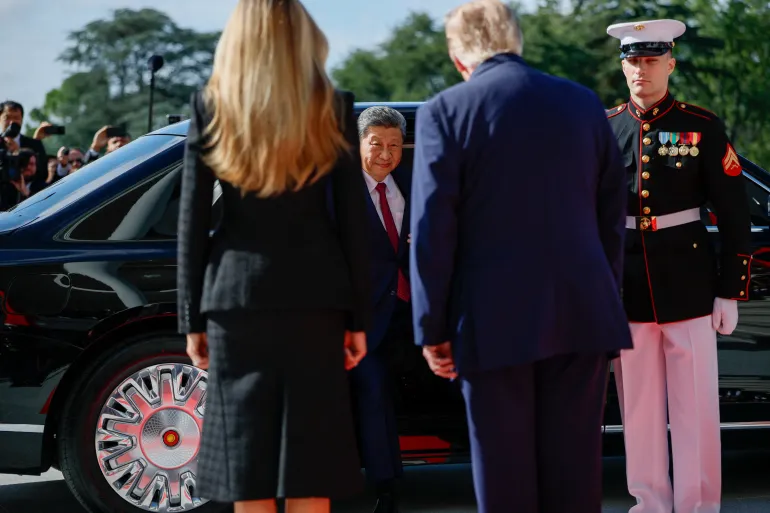
Xi arrived in Washington on Wednesday for his first visit to the United States in more than a decade. Trump personally welcomed the Chinese president and his wife, Peng Liyuan, at Joint Base Andrews ahead of Thursday's formal state visit.
The meeting comes as Washington and Beijing attempt to manage tensions between the world's two largest economies while maintaining a fragile pause in their trade confrontation.
The summit is the leaders' second meeting in 2026 and their third in-person meeting in less than a year, according to current reporting.
Trade Truce Takes Centre Stage
Trade is expected to be one of the most important issues at the summit.
The United States and China have spent much of the past two years imposing tariffs and export restrictions on each other's goods and technologies, disrupting supply chains and increasing uncertainty for businesses.
The latest trade truce, originally due to expire in November, has reportedly been extended until January 10, 2027, giving negotiators additional time to work towards a broader agreement.
US officials are expected to seek progress on agricultural purchases, non-tariff barriers and broader trade arrangements.
China, meanwhile, has strong leverage because of its position in global manufacturing and its control of important raw materials.
The summit therefore comes at a critical point for both countries as they attempt to prevent another escalation in tariffs.
Rare Earths and Critical Minerals
Critical minerals are another major issue.
China has a dominant position in the mining, processing and manufacturing of several rare-earth materials that are important to industries ranging from electronics and electric vehicles to defence and advanced technology.
Washington wants more reliable access to these materials and greater certainty for American companies.
Beijing, meanwhile, has sought assurances that the United States will not use export restrictions on advanced technology as a tool of economic pressure.
Previous Chinese restrictions on rare-earth exports demonstrated how quickly supply-chain disruptions can affect global industries.
Any agreement on mineral supplies or export controls could therefore have consequences far beyond the United States and China.
Artificial Intelligence Moves Higher on the Agenda
Artificial intelligence is also expected to feature prominently.
Washington and Beijing are competing for technological leadership in advanced AI, with both governments increasingly treating the technology as an economic and national-security issue.
At the same time, officials on both sides have expressed concern about the potential consequences of highly capable AI systems.
US and Chinese officials have discussed creating mechanisms that could allow them to communicate about serious AI-related incidents.
One proposal under consideration is a notification system for incidents that could threaten national security.
The challenge is that cooperation on AI is taking place against a backdrop of intense competition over semiconductors, computing power and advanced technology.
Taiwan Remains a Major Point of Tension
Taiwan is another sensitive issue.
China claims Taiwan as part of its territory, while Taiwan operates under its own democratic government. The United States maintains unofficial relations with Taiwan and has long provided it with defensive military equipment.
Washington's arms sales to Taiwan have repeatedly drawn objections from Beijing.
US officials and lawmakers are watching closely to see whether Taiwan becomes part of wider negotiations between Trump and Xi.
The issue is particularly sensitive because any perception that Washington is changing its approach to Taiwan could affect US relations with allies and partners across the Indo-Pacific.
Iran War Also Expected to Feature
The conflict involving Iran is another issue likely to be discussed.
China maintains close economic and diplomatic relations with Tehran and is a major buyer of Iranian oil.
The Trump administration has previously sought to pressure Iran economically and could look to Beijing's relationship with Tehran as a possible channel for influence.
US officials have discussed China's financial and economic ties with Iran, while Beijing has shown limited willingness to act in accordance with Washington's objectives.
Whether Trump can secure any Chinese assistance on Iran remains uncertain.
Americans Detained in China
The summit may also provide an opportunity for Trump to raise the cases of Americans and other individuals detained in China.
Trump has previously raised individual detention cases with Xi, including the case of Pastor Ezra Jin, whose release was secured in July, according to current reporting.
Human-rights and consular issues have historically been another source of friction between Washington and Beijing.
A Carefully Managed State Visit
Beyond the substantive negotiations, the visit has been carefully structured as a major diplomatic event.
The White House says Thursday's state arrival ceremony will involve 479 US military personnel representing all branches of the armed forces, with a military flyover featuring a B-2 Spirit and four F-22 Raptors.
Trump will host Xi for a state dinner at the White House on Thursday evening.
The visit concludes Friday with a meeting over tea and a visit by the two presidential couples to the National Archives.
What Both Governments Want
Although Washington and Beijing have different priorities, both governments have an interest in preventing their rivalry from developing into a wider economic or military confrontation.
For the United States, issues include market access, tariffs, critical minerals, technology competition and China's relationship with Iran.
For China, trade stability, access to technology, Taiwan and the treatment of Chinese companies by the US government are central concerns.
The talks therefore involve both cooperation and competition.
Why the Summit Matters
The Trump-Xi meeting matters beyond the two countries because decisions taken by Washington and Beijing can affect global trade, technology, energy markets and supply chains.
An escalation in tariffs could increase costs for companies and consumers.
Restrictions on critical minerals could affect manufacturing and high-tech industries.
Tensions over Taiwan could have wider security implications in Asia.
Meanwhile, agreements on trade, AI communication or supply-chain stability could reduce some of the uncertainty surrounding the US-China relationship.
Analysts have generally described the summit as an effort to manage tensions and preserve a fragile period of stability, rather than an expectation of a complete reset in relations.
What to Watch After the Meeting
The key indicators will include:
Whether the existing trade truce is extended or strengthened.
Any new commitments on US agricultural purchases by China.
China's position on rare-earth and critical-mineral exports.
US restrictions on advanced technology and semiconductors.
Whether the two governments establish a formal AI dialogue or incident-notification mechanism.
Any statements concerning Taiwan and US arms sales.
China's possible role in efforts involving Iran.
Progress on the cases of Americans detained in China.
The two governments are expected to communicate their respective positions separately rather than necessarily issuing a single joint statement.
Factful24 Takeaway
The Trump-Xi summit comes at a moment when the United States and China are attempting to prevent their economic and strategic rivalry from escalating while protecting their respective interests.
Trade remains central, but the agenda extends well beyond tariffs. Rare-earth minerals, AI, Taiwan, Iran and the treatment of detained citizens all reflect the increasingly broad nature of US-China relations.
The outcome of the meeting could influence not only bilateral relations but also global supply chains, technology markets and geopolitical stability in the months ahead.
Sources: Reuters, Al Jazeera, The White House and World Economic Forum reporting published in September 2026.