
Middle East | News
Gaza Recovery Bill Hits $71.5 Billion as UN Reports 92% of Economic Establishments Damaged
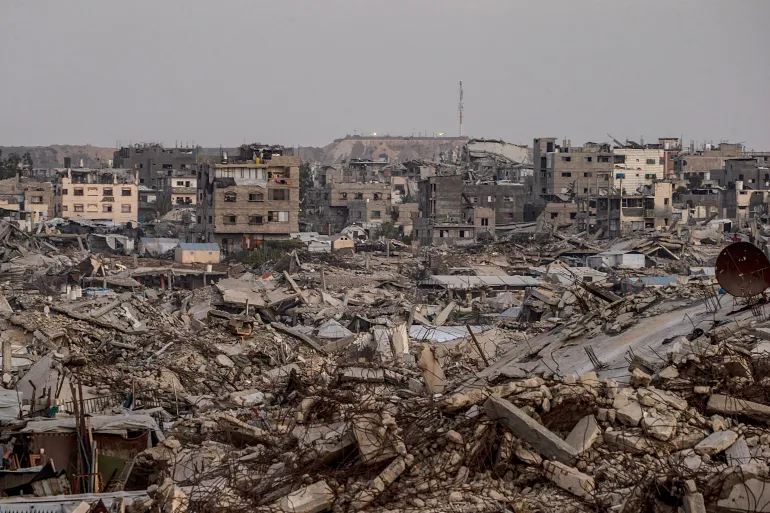
Geneva, September 24, 2026 — The economic devastation in Gaza has reached a scale that will require an estimated $71.5 billion for recovery and reconstruction, according to a new report by the United Nations Conference on Trade and Development (UNCTAD).
The report, presented to the UN Trade and Development Board on Thursday, describes a dramatic collapse in Gaza's productive capacity, employment and living standards following the destruction and disruption that began after October 2023.
UNCTAD says 92% of Gaza's economic establishments have been damaged or destroyed, while the territory's productive sectors remain far below their pre-war levels.
The assessment puts physical infrastructure damage at approximately $35.2 billion, while economic and social losses are estimated at another $22.7 billion.
The $71.5 billion figure represents the estimated total recovery and reconstruction requirement and could increase if additional damage continues to be recorded.
Gaza's Economy Has Contracted Dramatically
According to UNCTAD, Gaza's economy suffered an unprecedented contraction during the period covered by the report.
Real GDP contracted by 83% in 2024 before recording a 34.2% increase in 2025. UNCTAD cautions that the 2025 increase represents a statistical rebound from an exceptionally low base rather than a return to normal economic activity.
Gaza's GDP per capita stood at just $212 in 2025, equivalent to roughly $0.58 per person per day in GDP terms and only 17% of its 2022 level.
Gaza's share of the wider Palestinian economy also fell sharply, from 17.4% before October 2023 to less than 4% in 2025.
Unemployment Reaches 78%
The labour market has also suffered extensive damage.
UNCTAD estimates Gaza's unemployment rate reached 78%, while more than 90% of the working-age population was without employment in 2025.
Only about 123,300 people were employed during the year, according to the report.
Across the Occupied Palestinian Territory, hundreds of thousands of jobs have been lost since October 2023, resulting in an estimated $2.8 billion in cumulative lost labour income.
Agriculture, Industry and Construction Devastated
The destruction has affected virtually every major productive sector.
Compared with 2022 levels, UNCTAD estimates that in 2025:
Agricultural output was down 94%
Industrial output was down 94%
Construction output was down 99%
The report also says that less than 1.5% of Gaza's cropland remained both accessible and undamaged, increasing dependence on humanitarian food assistance.
The destruction of productive infrastructure means that reconstruction will require more than rebuilding homes and roads. Restoring agriculture, industry, energy, technology and other economic sectors will be essential if Gaza is to regain sustainable economic activity.
Prices Remain Far Above Pre-War Levels
The economic crisis has also translated into dramatically higher prices.
UNCTAD estimates that Gaza's overall price level in 2025 remained 274% above its 2022 level.
Basic commodities have been particularly affected, with the report highlighting substantial increases in the prices of food and cooking fuel.
The combination of destroyed businesses, disrupted supply chains, reduced employment and limited productive capacity has placed additional pressure on household incomes and access to basic goods.
Health and Education Systems Under Pressure
The reconstruction challenge extends to Gaza's health and education infrastructure.
The UN-backed damage assessment found extensive damage to health and educational facilities, with more than half of hospitals and primary health clinics non-functional.
The destruction of agricultural land and productive facilities has also increased dependence on humanitarian assistance.
UNCTAD says housing represents the largest category of physical damage and the largest reconstruction requirement.
Infrastructure Damage Estimated at $35.2 Billion
The World Bank, European Union and United Nations carried out a rapid damage and needs assessment that estimated Gaza's physical infrastructure damage at approximately $35.2 billion as of early 2026.
Economic and social losses were estimated at a further $22.7 billion.
The assessment places total recovery and reconstruction requirements at approximately $71.5 billion.
UNCTAD cautions that the figure could rise if additional destruction occurs before conditions allow sustained recovery and reconstruction.
Gaza's Crisis Is Part of a Wider Palestinian Economic Problem
The UN report also examines economic conditions in the West Bank and the finances of the Palestinian government.
UNCTAD says the Palestinian government's fiscal position has deteriorated significantly, with cumulative deductions and withheld revenues between January 2019 and March 2026 exceeding an estimated $3.67 billion.
The report says this was equivalent to approximately 83% of the Palestinian government's net revenue in 2025.
The financial pressure has affected public services.
Health-related arrears reportedly reached approximately $1.1 billion by late 2025, while resource shortages in the West Bank resulted in schools limiting in-person instruction to three days per week in 2025, according to UNCTAD.
Palestinian Banking Sector Also Faces Pressure
The financial crisis has also extended to Palestinian banks.
The Palestinian government has increasingly borrowed from domestic banks while accumulating arrears to private-sector suppliers and the pension fund.
UNCTAD estimates public debt at $4.8 billion in 2025.
When lending secured against government salaries is included, the banking sector's exposure to the public sector reached approximately $5.3 billion, equivalent to 42% of total bank lending.
UNCTAD warns that restrictions affecting Palestinian banks could make it more difficult to finance imports of essential goods such as fuel, medicines and food.
What Will Gaza's Recovery Require?
The UN report says reconstruction cannot focus exclusively on replacing damaged buildings.
It identifies the rebuilding of productive capacity in areas including:
Agriculture
Industry
Construction
Energy
Technology
Housing
Health
Education
as important components of a sustainable recovery.
UNCTAD identifies three immediate priorities: the transfer of withheld Palestinian revenues, protection of the Palestinian banking system and ensuring that reconstruction assistance reflects the documented scale of the destruction and economic losses.
A $71.5 Billion Challenge
The scale of the financial requirement highlights the enormous challenge facing any future reconstruction effort.
The $71.5 billion estimate is substantially larger than the $2.4 billion initial reconstruction plan announced by the US-backed Board of Peace, which covers an initial set of projects rather than the full long-term reconstruction requirement. Al Jazeera reported that the broader reconstruction plan is expected to require tens of billions of dollars over the medium and longer term.
This means that even if a ceasefire is sustained, rebuilding Gaza's housing, infrastructure and economy will require years of international financial and technical support.
Factful24 Verification Note
UNCTAD estimates Gaza's total recovery and reconstruction needs at $71.5 billion
Estimated physical infrastructure damage: $35.2 billion
Estimated economic and social losses: $22.7 billion
Economic establishments damaged or destroyed: 92%
Gaza unemployment rate in 2025: 78%
GDP per capita in 2025: $212
Agricultural output compared with 2022: Down 94%
Industrial output compared with 2022: Down 94%
Construction output compared with 2022: Down 99%
These figures come from the latest UNCTAD report and associated World Bank, EU and UN damage assessment cited by the report.
Factful24 Takeaway
The latest UN assessment indicates that Gaza's recovery challenge extends far beyond rebuilding damaged structures.
The destruction has severely affected employment, agriculture, industry, construction, healthcare, education, banking and household purchasing power.
With total recovery and reconstruction requirements estimated at $71.5 billion, the scale of the challenge will depend not only on the availability of international funding but also on sustained security conditions, access to Gaza, functioning financial institutions and the restoration of productive economic activity.
The UN assessment provides an economic measure of the damage, but the ultimate cost of recovery could change as conditions on the ground evolve.
Source: UN Trade and Development (UNCTAD), Report on UNCTAD assistance to the Palestinian people, September 24, 2026; World Bank, European Union and United Nations damage and needs assessment