
Middle East | News
Netanyahu’s UN Speech Puts International Pressure and Israeli Election Under the Spotlight
Israeli Prime Minister Benjamin Netanyahu is facing an unusually consequential moment as he prepares to address the United Nations General Assembly in New York, with his speech attracting attention both internationally and at home in Israel, where a national election is scheduled for October 27.
Netanyahu’s appearance comes amid continuing international criticism of Israel over its military operations in Gaza and the occupied West Bank, tensions surrounding Iran, and questions about Israel’s relationship with the United States and other Western governments.
At the same time, the Israeli prime minister is seeking another term in office, making the UN appearance an important political event for an Israeli domestic audience as well as an international diplomatic one. Al Jazeera reported that Netanyahu has increasingly presented himself to Israeli voters as the country’s principal voice on the international stage.
Why Netanyahu’s UN Appearance Matters
Netanyahu is a veteran of UN diplomacy and is appearing before the General Assembly for the 15th time.
His speeches at the United Nations have historically been closely followed in Israel, where his confrontational approach toward international criticism has been part of his political identity.
According to analysts quoted by Al Jazeera, the prime minister's speech is expected to receive extensive coverage by Israeli television networks and could dominate the country's news cycle.
Nimrod Goren, president of the Israeli Institute for Regional Foreign Policies, told Al Jazeera that Netanyahu is entering the UN with the upcoming Israeli election firmly in view.
The timing is significant because the election is less than five weeks away.
A Message for Two Audiences
Netanyahu's challenge is that he is addressing two very different audiences simultaneously.
At the United Nations, he is expected to defend Israel's position before representatives of governments that have increasingly criticised its actions in Gaza and the West Bank.
At home, his speech is being watched by Israeli voters who will decide whether his political coalition returns to power.
Al Jazeera cited former Israeli consul general in New York Alon Pinkas, who described Netanyahu's UN appearances as an established part of his political communication with Israelis.
The prime minister's address is therefore likely to be judged not only by diplomats and foreign governments but also by Israeli television viewers and voters following the speech from home.
International Criticism Has Intensified
Netanyahu is arriving at the UN during a period of intense international disagreement over Israel's conduct in Gaza and the occupied West Bank.
Israel has rejected accusations that its military campaign constitutes genocide and has continued to defend its security policies.
The United Nations and various international bodies, however, have repeatedly raised concerns over civilian casualties, humanitarian conditions and alleged violations of international law.
These disagreements have contributed to an increasingly strained relationship between Israel and parts of the international community.
Al Jazeera reported that the UN has become a particularly contentious arena for Israel, with Israeli officials frequently arguing that the organisation displays institutional bias against the country.
Gaza, Iran and Israel’s Security
The speech also comes as Israel remains involved in a broader regional security crisis.
The conflict involving Iran is expected to feature prominently in Netanyahu's remarks. The Times of Israel reported that his address was expected to focus on Iran, the Gaza war and security concerns involving the West Bank.
Netanyahu is likely to use the international platform to emphasise Israel's security concerns and its position that the country must be able to defend itself against armed groups and hostile states.
His government has consistently placed national security at the centre of its public messaging.
The Trump Factor
Another important backdrop to Netanyahu's visit is his relationship with US President Donald Trump.
Unlike previous UN trips, Netanyahu's current visit does not include a scheduled meeting with Trump.
The absence has attracted considerable attention because Washington remains Israel's most important international ally.
CBS reported that Netanyahu arrived in New York on Thursday and was expected to leave only hours after delivering his speech.
The Times of Israel also reported that Netanyahu's visit would be unusually brief and that no meeting with Trump was scheduled.
The lack of a presidential meeting has generated different interpretations among analysts, with some viewing it as evidence of tensions while others caution against concluding scheduling decisions alone.
Protests Await Netanyahu in New York
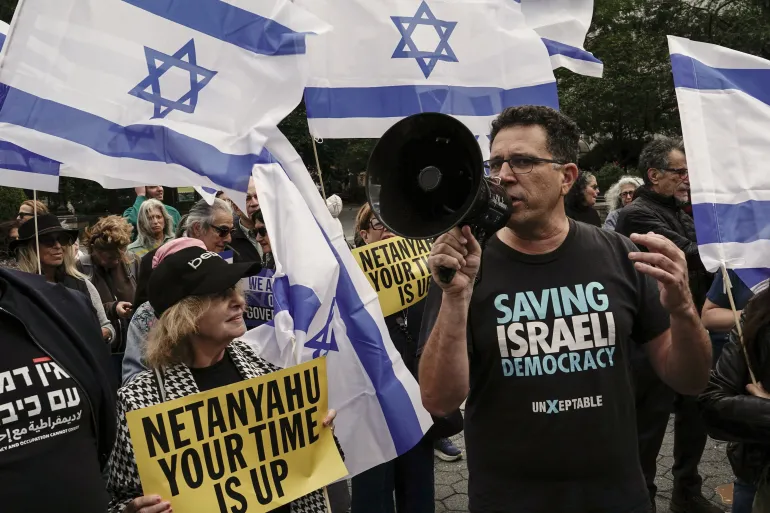
Netanyahu's appearance has also been accompanied by demonstrations in New York.
The Guardian reported that hundreds of protesters gathered outside the United Nations as Netanyahu prepared to speak, with demonstrators including Jewish, Palestinian, Iranian and Lebanese New Yorkers as well as political activists and elected officials.
Protesters have criticised Israel's military campaign in Gaza and called for changes to US policy toward Israel.
At the same time, Netanyahu retains supporters in Israel and among parts of the Jewish community abroad who argue that his government is defending Israel against serious security threats.
The demonstrations therefore reflect the wider political divisions surrounding Israel's policies, rather than representing a single unified public position.
Netanyahu’s Political Challenge at Home
The October 27 Israeli election adds another layer of significance to the UN appearance.
Current reporting indicates that Netanyahu and his political allies face a difficult electoral environment, with polling cited by Israeli media showing his bloc below the 61-seat threshold required to form a government independently.
Those figures are polling measurements rather than election results and can change before voting takes place.
Netanyahu is also facing domestic criticism connected to the security failures surrounding the October 7, 2023 Hamas-led attacks, the continuing wars and disagreements over military and religious policy.
His supporters, however, continue to portray him as an experienced leader capable of confronting Israel's external security challenges and representing the country internationally.
Why the UN Stage Is Particularly Important
For Netanyahu, the United Nations provides a platform from which he can speak directly to both international leaders and Israelis watching at home.
His political strategy has frequently involved presenting international criticism as evidence that Israel must remain strong and resist external pressure.
That approach resonates with some Israeli voters, while others argue that Israel's international standing and diplomatic relationships have suffered under his government.
The disagreement is likely to be particularly visible during this election campaign.
What to Watch in Netanyahu’s Speech
Several issues are expected to receive particular attention:
Iran: Netanyahu's assessment of the Iranian threat and Israel's regional security.
Gaza: Israel's justification of its military actions and response to international criticism.
West Bank: Security concerns and international criticism concerning Israeli settlements and settler violence.
United States: The state of Israel-US relations and the absence of a scheduled Trump-Netanyahu meeting.
International pressure: Netanyahu's response to criticism from governments and international organisations.
Israel's election: Although the speech is formally an international diplomatic address, its impact on Israeli voters will be closely watched.
A Speech With Consequences Beyond the UN Hall
Netanyahu's UN appearance is taking place at the intersection of diplomacy, war and domestic politics.
Internationally, his speech will be assessed against the backdrop of Israel's increasingly contentious relationship with the UN and criticism over Gaza and the West Bank.
Domestically, Israeli voters will be watching a prime minister seeking another term less than five weeks before an election.
The speech therefore represents more than another appearance on the UN podium. It is simultaneously a statement of Israeli foreign policy, a defence of the government's position on regional security and an opportunity for Netanyahu to communicate directly with voters at home.
Whether the address changes public opinion or Israel's international relationships cannot be established in advance. What is clear is that the speech is arriving at a politically sensitive moment for Netanyahu and for Israel's relationship with the international community.
Factful24 Verification Note
Israeli election: Scheduled for October 27, 2026.
UN appearance: Netanyahu is addressing the 81st UN General Assembly in New York on September 24, 2026.
Trump meeting: No meeting between Netanyahu and US President Donald Trump was scheduled during this visit, according to current reporting.
Protests: Demonstrations were reported in New York ahead of and during Netanyahu's appearance.
Political context: Polling cited by Israeli media has shown Netanyahu's bloc below the 61-seat threshold needed to form a government, but polling is not an election result.
Source: Al Jazeera, with additional verification from Associated Press/CBS reporting and Israeli media.