
Middle East | News
Three Years of War Have Transformed Gaza
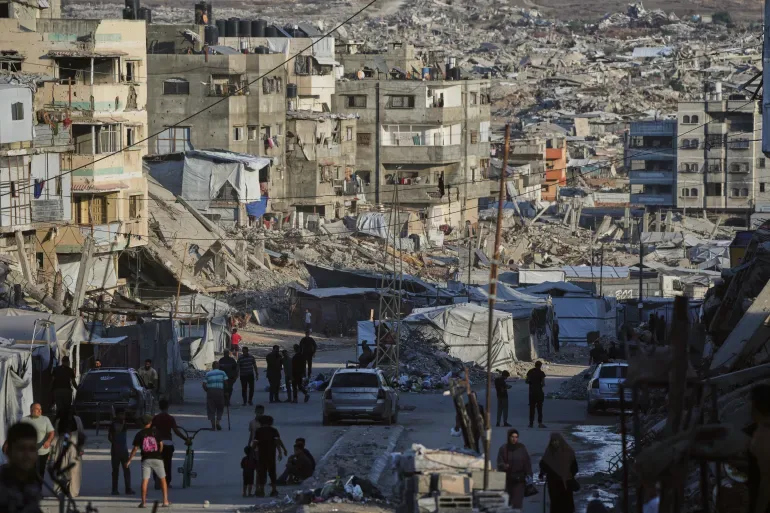
Three years after the Hamas-led October 7, 2023 attack on Israel triggered the current war, Gaza has been reshaped by mass death, displacement and the destruction of homes, schools, hospitals, businesses and basic infrastructure.
More than 74,245 Palestinians had been reported killed by Gaza’s Ministry of Health, according to Al Jazeera’s anniversary assessment, while thousands more were missing or believed to be beneath the rubble.
The term “genocide” remains legally and politically contested. It is used by some organisations and commentators to describe Israel’s military campaign, but Factful24 attributes that characterisation rather than presenting it as an uncontested legal finding.
What is clear from United Nations and humanitarian reporting is the scale of Gaza’s civilian crisis.
Displacement Has Become Everyday Life
Repeated evacuation orders and military operations have forced many Palestinians to move multiple times.
By late September, the UN Office for the Coordination of Humanitarian Affairs, OCHA, reported that about 279,000 people were living in 400 flood-prone displacement sites. More than 2,300 unsafe buildings requiring demolition remained occupied, sheltering almost 44,000 people.
The crisis is therefore not only about finding shelter. Displaced families also need access to:
- Clean water and sanitation
- Food and cooking facilities
- Electricity and fuel
- Healthcare
- Protection from flooding and extreme weather
- Safe routes for movement
As winter approaches, humanitarian agencies have been trying to improve drainage and reinforce shelters. However, funding shortages, insecurity and restrictions on access and imported materials continue to limit those efforts.
Water and Electricity Remain Scarce
Gaza’s water and electricity systems have been severely affected by the war.
Al Jazeera reported that 91 percent of assessed households experienced moderate-to-high water insecurity in early August. Gaza’s electricity grid has also remained largely non-functional, leaving homes and essential services dependent on generators and whatever fuel is available.
This has changed ordinary routines. Charging a phone, cooking food, washing clothes, collecting water or traveling to a hospital can require significant planning and resources.
Daily life is increasingly organized around survival rather than convenience.
Economy Has Collapsed
The war has destroyed much of Gaza’s productive capacity.
According to figures cited by AlJazeera from the UN Conference on Trade and Development:
- 92 percent of economic establishments had been damaged or destroyed.
- Unemployment had reached 78 percent.
- GDP per capita fell to about $212 in 2025—roughly 17 percent of its 2022 level.
- Agriculture and industry were operating at about 6 percent of their 2022 output.
- Construction had declined to approximately 1 percent of its previous output.
- Prices remained about 200 percent above pre-war levels in September.
The destruction of a shop affects more than the building itself. It can eliminate a family’s income, workers’ livelihoods, suppliers’ customers and a community’s access to essential goods.
With conventional employment severely reduced, many families have become dependent on humanitarian assistance, informal work, debt and small-scale trade.
Children Are Losing Years of Education
Gaza’s education system has been devastated.
UNICEF figures cited by Al Jazeera indicate that nearly 98 percent of schools have been damaged or destroyed. By April 2026, about 700,000 children aged four to 17 had missed almost three consecutive years of regular in-person education, while approximately 200,000 children had no access to education.
Many schools that remain standing have been converted into shelters.
The consequences go beyond missed examinations. Extended disruption can affect literacy, numeracy, social development, mental health and children’s ability to return to regular classroom routines.
Rebuilding school buildings may be possible. Recovering years of lost learning and childhood will be considerably more difficult.
Healthcare System Near Collapse
The healthcare system has also suffered severe physical and operational damage.
The World Health Organization reported that all 36 hospitals in Gaza had been damaged, with only 19 functioning at the time of Al Jazeera’s assessment. None was operating at full capacity.
Hospitals have faced shortages of:
- Medicines
- Medical equipment
- Diagnostic supplies
- Fuel
- Specialist staff
- Safe treatment space
The consequences affect both people injured in military operations and patients requiring ongoing care for cancer, kidney disease, chronic illnesses and other conditions.
The WHO has also warned that overcrowding, poor sanitation, inadequate shelter and weakened health services increase the risk of disease outbreaks.
Gaza’s Physical Map Has Changed
Satellite imagery shows the scale of the physical transformation.
An analysis reported that about 82 percent of Gaza’s structures—roughly 200,000 buildings—had been damaged, with around two-thirds of those destroyed.
Residential neighborhoods, roads, farmland, schools, places of worship and public facilities have been heavily affected.
The destruction of a neighborhood also breaks apart the social networks built around it. When homes, schools, businesses, roads and public spaces disappear, families may lose not only property but also community ties and local support systems.
Rafah illustrates the scale of this disruption. More than 800,000 people were displaced from the city during Israel’s military operation there in May 2024, according to UN estimates cited in the assessment.
For many Palestinians, returning home may no longer mean returning to the place they remember.
Ceasefire Did Not Restore Normal Life
A ceasefire announced in October 2025 changed the character of the conflict but did not immediately resolve Gaza’s humanitarian crisis.
Al Jazeera reported that Gaza’s Ministry of Health recorded another 1,462 Palestinian deaths after the ceasefire took effect. OCHA also continued to report casualties, restrictions on humanitarian access and severe shortages.
Between September 23 and 30, OCHA reported that 29 Palestinians were killed and 147 injured, based on figures from Gaza’s Ministry of Health.
The experience demonstrates that stopping large-scale fighting does not automatically:
- Rebuild hospitals
- Restore electricity
- Reopen schools
- Clear rubble
- Repair water systems
- Return displaced families home
- Restore livelihoods
The Human Cost
The death toll does not capture the full impact of the war.
It does not measure children growing up without classrooms, families living in tents, patients unable to access specialized treatment, businesses that have disappeared or communities that have lost their homes.
Nor does it fully capture the psychological effect of repeated displacement, bereavement and uncertainty.
The suffering of Palestinians in Gaza also exists alongside the trauma experienced by Israelis affected by the October 7 attack. Reuters reported that the attack killed about 1,200 people and resulted in 251 hostages being taken.
These are distinct dimensions of the conflict, and acknowledging one does not erase the other.
What Comes Next
Gaza now faces a reconstruction challenge that could last for generations.
The immediate needs include:
- Rebuilding homes, hospitals and schools
- Restoring water and electricity
- Clearing rubble and explosive remnants
- Re-establishing healthcare and education
- Reviving agriculture, industry and commerce
- Providing safe conditions for displaced families to return
There are also difficult political questions about future governance, security, borders, reconstruction funding and civilian rights.
Physical reconstruction alone cannot resolve the underlying political conflict. Without a sustainable political settlement and credible guarantees of civilian safety, rebuilt communities could remain vulnerable to another cycle of destruction.
Bottom Line
Three years of war have transformed Gaza through mass death, repeated displacement, economic collapse and the breakdown of education, healthcare and essential services.
The term “genocide” remains contested in legal and political terms, but the humanitarian evidence documents extraordinary civilian suffering and destruction.
The challenge facing Gaza is no longer only how to end the fighting. It is how to rebuild a society in which families can live safely, children can return to school, hospitals can function and displaced people can regain a realistic path to a secure future.
{Source: Aljazeera}