

United Kingdom | News
Russell Brand Trial Opens: Prosecutors Accuse Comedian of Being a ‘Sexual Predator’
UK News | Entertainment | Court Report | October 14, 2026
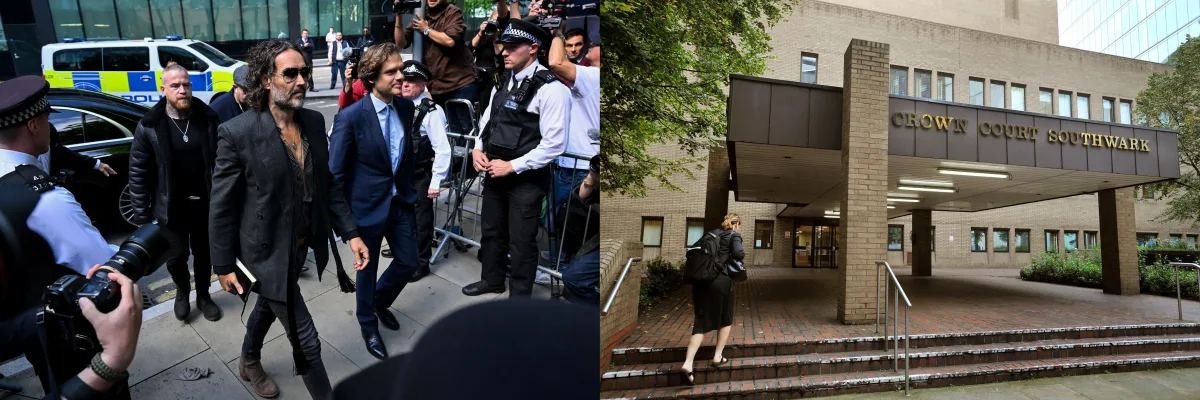
British comedian and actor Russell Brand has gone on trial in London over allegations of rape and other sexual offences involving six women, with prosecutors describing him as a “ruthless, calculating and manipulative” sexual predator.
At the opening of the case on Wednesday, October 14, prosecutor Riel Karmy-Jones told jurors at Southwark Crown Court that the alleged offences occurred between 1999 and 2009, during a period when Brand's entertainment career was growing. She argued that he used his charm and public profile in pursuing sexual encounters with women.
Brand denies all seven charges and has pleaded not guilty. The prosecution's opening statement presents the allegations the jury will consider; it is not a verdict or a finding of guilt.
The seven charges facing Russell Brand
The 51-year-old entertainer faces seven charges relating to six women and alleged incidents spanning a decade. The charges comprise:
- Three counts of rape.
- Three counts of sexual assault.
- One count of indecent assault.
The alleged incidents are said to have occurred in different settings, including a hotel room, workplaces, a bar's toilet cubicle and Brand's home.
What prosecutors told the court
The prosecution outlined several allegations dating from the period between 1999 and 2009.
The earliest allegation concerns an encounter in 1999, when Brand was performing at an event held alongside the Labour Party conference in Bournemouth. A woman alleges that he raped her in her hotel room.
Another allegation relates to 2001, when a woman working at MTV is said to have been subjected to an unwanted advance involving an attempt to pull her into a toilet cubicle.
Prosecutors also outlined allegations concerning an incident at a London bar in 2004, an alleged indecent assault involving a media worker in 2004 or 2005, and incidents involving two other women in 2009. One of the latter allegations concerns a woman who says she initially had consensual sex with Brand before he raped her. Another concerns an alleged unwanted sexual encounter during an advertising recording.
These accounts remain allegations to be tested through witness testimony and other evidence during the trial.
Former friend gives evidence about 1999 incident
Mark Pinheiro, a former friend and fellow performer who accompanied Brand to Bournemouth in 1999, was the first witness to give evidence.
Pinheiro told the court that Brand returned to their accommodation appearing distressed and that the group left the area abruptly. He also recalled a later conversation in which Brand allegedly said that an encounter with a woman might have “gone a little bit too far.”
Brand's barrister, Ian Winter, challenged Pinheiro's recollection, questioning whether the conversation had occurred as described and highlighting that it had not been mentioned when Pinheiro first contacted police. Pinheiro rejected that challenge.
The jury will have to assess this evidence alongside the other testimony and the defense' responses.
Why the allegations came to police years later
Prosecutors said the six women did not know one another and came forward independently after a television investigation and a newspaper report in 2023 brought allegations about Brand into public view.
According to the prosecution, the women had not reported the alleged incidents at the time because of feelings including shame, guilt and concern that they would not be believed.
The timing of the reports is part of the context the jury will consider. The allegations date back many years, making witness recollections, contemporaneous communications and other available evidence important to the proceedings.
Russell Brand's response
Brand has consistently denied engaging in non-consensual sexual activity. Prosecutors told the court that, when interviewed by police, he declined to answer questions but supplied written statements in which he said he did not remember the incidents and had never engaged in non-consensual activity.
Speaking briefly as he arrived at court on Wednesday, Brand said he felt concerned but hopeful that the proceedings would lead to good outcomes for everyone involved.
The case is expected to take several weeks. The jury must evaluate the evidence presented in court before reaching any verdict.
From mainstream entertainment to online media
Brand rose to prominence in Britain during the 2000s as a stand-up comedian, television presenter and radio host. He later appeared in Hollywood productions, including Forgetting Sarah Marshall and Get Him to the Greek.
He was married to American singer Katy Perry from 2010 until their divorce in 2012. In more recent years, he has focused on online broadcasting, discussing religion, wellness, politics and free speech.
The criminal trial has renewed scrutiny of his past conduct and public career, but the legal question before the court is whether the prosecution can prove the charges against him.
Note:
The opening of Russell Brand's trial marks a significant stage in a criminal case involving seven charges and six complainants, with alleged incidents dating from 1999 to 2009.
The prosecution has presented its account of the alleged pattern of behavior, and a former friend has begun giving evidence about one of the earliest allegations. Brand denies all the charges, and the defense has challenged aspects of the witness evidence.
The central distinction is between an accusation and a proven offense. The allegations are serious, but the outcome must be determined through the court process and the evidence heard by the jury.
The case will also draw attention to the challenges involved when allegations of sexual violence are reported years after the events in question, including how courts assess witness testimony and other evidence fairly.
Sources: BBC News