

Politics
Shettima Says APC’s Internal Divisions Concern Him More Than Atiku and Obi Ahead of 2027 Polls
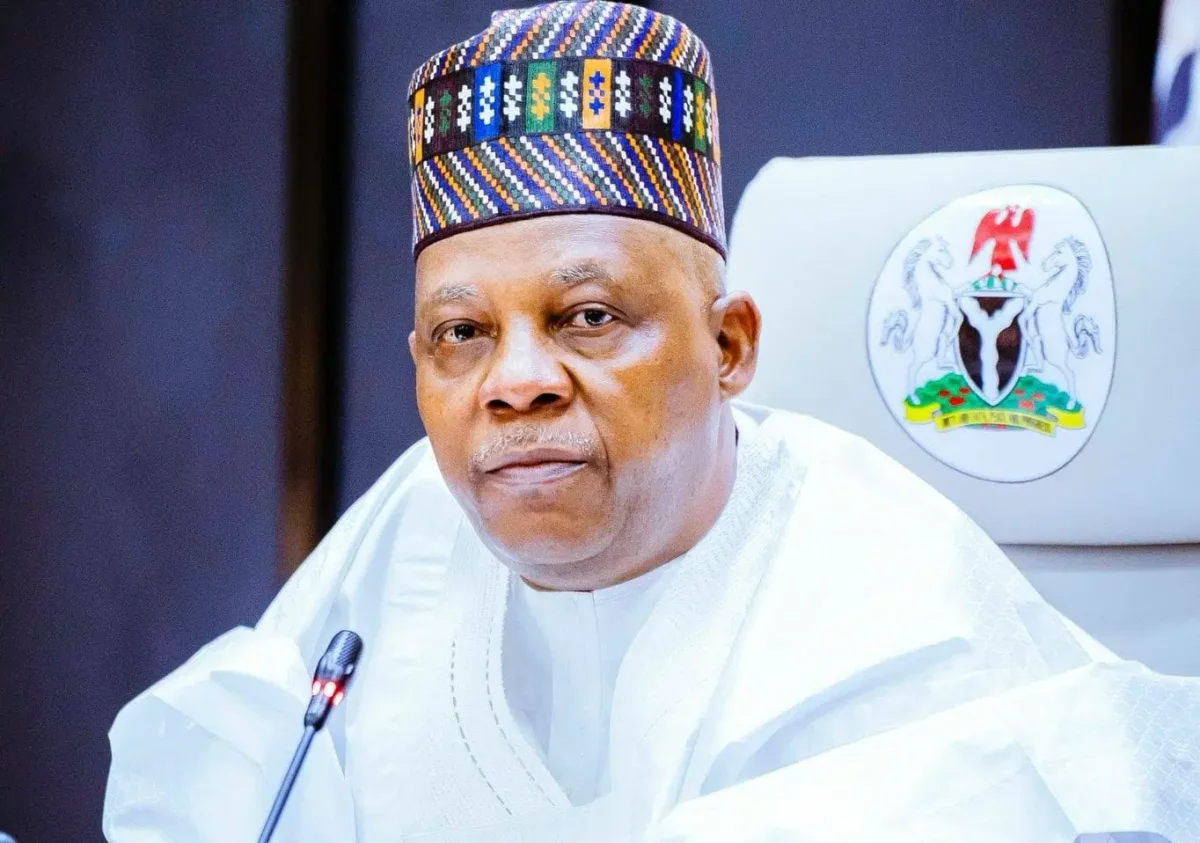
Nigeria’s Vice-President, Kashim Shettima, has warned that internal divisions within the ruling All Progressives Congress (APC) pose a greater concern to the party’s 2027 re-election campaign than opposition figures Atiku Abubakar and Peter Obi.
Shettima made the remarks on Saturday, October 17, 2026, in Abuja during the unveiling of the campaign headquarters of Arewa for Asiwaju (A4A), a northern political coalition supporting the re-election of President Bola Ahmed Tinubu and Shettima.
According to Vanguard, the Vice-President said he was less concerned about the opposition than about contradictions within his own political organisation. He urged APC members to close ranks and avoid undermining one another as the country approaches the 2027 general elections.
The remarks are significant because they acknowledge a challenge facing the governing party: a national campaign depends not only on confronting political opponents, but also on maintaining cooperation among party leaders, governors, elected representatives and grassroots organisers.
What Shettima said about the APC’s biggest challenge
Shettima told supporters that party unity mattered more than concentrating exclusively on the opposition.
He said:
“I am more afraid of internal contradictions within our household.”
He also warned northern political leaders against supporting Tinubu’s presidential campaign while weakening APC governors or other party candidates contesting elections in their own states.
His message was that the party must coordinate its presidential, governorship and legislative campaigns rather than allow competing ambitions to undermine its wider electoral effort.
The warning points to a practical political problem: a party may have a large national organisation but still face difficulties if its state-level leaders are divided over candidates, influence, campaign resources or local political alliances.
Why internal unity matters ahead of 2027
1. Presidential and state campaigns must work together
Shettima argued that leaders should not prioritise the presidential contest at the expense of their party’s governorship candidates. Disagreement between national and state political figures can complicate campaign coordination.
2. Grassroots organisation needs accountability
The Vice-President cited the country's 176,845 polling units and said the APC had 361,045 officials across its structures. He also called on political appointees to demonstrate their strength in their own polling units, wards and local government areas. These figures and expectations were claims made in his address.
3. Political endorsements are not the same as votes
Shettima said the North had made its choice and expressed confidence in support for Tinubu. Such statements reflect the campaign’s assessment; actual voter preferences cannot be established by a rally or endorsement alone.
The campaign’s message to northern Nigeria
Shettima said the North had “spoken with a resounding voice and unmistakable conviction” in support of Tinubu. He also assured northern voters that the region had nothing to fear from a second Tinubu term.
At the same event, APC National Chairman Nentawe Yilwatda called for a renewed mandate and cited federal infrastructure projects, including the Abuja–Kaduna–Kano and Kano–Maiduguri roads, as part of the administration’s case for re-election.
Former Jigawa State governor Muhammad Badaru Abubakar and A4A Director-General also presented the new campaign headquarters as a base for organising support across markets, farms, campuses and religious communities.
These declarations show how the coalition is framing its campaign, but they do not establish that northern voters uniformly support Tinubu. The region contains diverse political interests and voting histories.
Shettima also defended Tinubu’s economic record
The Vice-President argued that Tinubu inherited a severely weakened economy and credited the administration with improving Nigeria’s external reserves.
He claimed that reserves had risen to approximately $58.9 billion, compared with $3.9 billion when Tinubu took office. He also referred to the previous administration’s use of Ways and Means financing, which he said had exceeded ₦27 trillion.
Those figures should be treated as claims made at the political event unless independently reconciled against dated Central Bank of Nigeria data and official debt records. Foreign reserves can fluctuate, and gross reserves do not necessarily equal the amount readily available for government spending or other uses.
Shettima also acknowledged that many Nigerian households were still struggling to make ends meet. He cautioned party members against relying only on applause, saying that leaders risk losing touch with public concerns when they hear only praise.
That acknowledgement is relevant to the campaign’s credibility: economic indicators and government announcements need to be assessed alongside the cost of living, household incomes, employment and the everyday experiences of Nigerians.
What this means for Atiku and Obi
Shettima specifically mentioned Atiku Abubakar and Peter Obi as opposition figures he was less concerned about than internal APC divisions. He also urged party supporters to challenge Atiku respectfully.
His remarks came amid wider political exchanges over Tinubu’s re-election campaign. Atiku and Obi’s political representatives have criticised the President’s reliance on campaign surrogates, arguing that he should personally defend his administration’s record before voters. Tinubu, meanwhile, has said his governance responsibilities and economic obligations mean he will not attend every campaign rally.
The disagreement reflects two competing campaign messages: the APC is emphasising its political organisation and the continuation of its policies, while opposition figures are pressing the President to answer directly for the results of his administration.
Note:
Shettima’s warning is an unusually direct acknowledgement that internal party cohesion is a concern for the APC as it prepares for 2027. He has urged members to coordinate national and state campaigns, hold political appointees accountable for grassroots performance and avoid internal competition that could weaken the party’s efforts.
His confidence in Tinubu’s northern support remains a political assertion, not an independently verified measure of voter opinion. The larger test for the APC will be whether it can maintain internal cooperation while addressing public concerns over economic hardship and demonstrating the results of its policies.
Sources
Vanguard — APC’s internal contradictions scare me more than Atiku, Obi — Shettima