

Middle East | News
Why US–Iran Negotiations Keep Failing: History, Mistrust and the Battle Over Who Moves First
October 19, 2026
As diplomatic efforts struggle to end the war, Washington and Tehran remain divided over nuclear restrictions, sanctions relief, maritime security and guarantees that any agreement will survive.
Repeated efforts to negotiate an end to the conflict between the United States and Iran have failed to produce a durable settlement, raising questions about whether diplomacy can overcome the decades of mistrust separating the two countries.
In an opinion article published by Al Jazeera on October 18, academic and Middle East political analyst Mahjoob Zweiri argues that the persistent diplomatic deadlock cannot be explained by disagreements over individual proposals alone. Instead, he attributes much of the failure to the historical experiences that have shaped how Washington and Tehran perceive each other’s intentions.
The analysis identifies a recurring problem: American negotiators want Iran to take verifiable steps before receiving major concessions, while Iranian leaders want credible guarantees and relief from pressure before making commitments of their own.
That disagreement over the order of concessions has become one of the central obstacles to a settlement.
The immediate stakes extend beyond the two countries. The conflict has disrupted regional security and energy markets, while uncertainty over the Strait of Hormuz has raised concerns about international shipping, oil and gas supplies, and the wider global economy.
The historical roots of the mistrust
Zweiri traces the breakdown in relations to several major events, beginning with the 1953 overthrow of Iranian Prime Minister Mohammad Mosaddegh.
After Mosaddegh nationalised Iran’s oil industry, a coup backed by US and British intelligence helped remove his government. The episode became a defining part of Iran’s political memory and contributed to enduring suspicions about Western interference in Iranian affairs.
The next major rupture came after Iran’s 1979 revolution, which overthrew the monarchy.
In November that year, Iranian students seized the US embassy in Tehran and held 52 Americans hostage for 444 days. The crisis ended diplomatic relations between the two countries and reinforced Washington’s view of the Iranian government as an unreliable negotiating partner.
These events created competing historical narratives. Many in Iran view American intervention as evidence that Washington may seek to weaken or overturn governments that challenge its interests. In the United States, the embassy hostage crisis remains a powerful symbol of Iran’s hostility toward American diplomatic and security interests.
Zweiri argues that these experiences have become more than historical grievances: they influence what each side considers an acceptable agreement and the safeguards it believes are necessary.
Trump’s 2018 withdrawal from the nuclear agreement
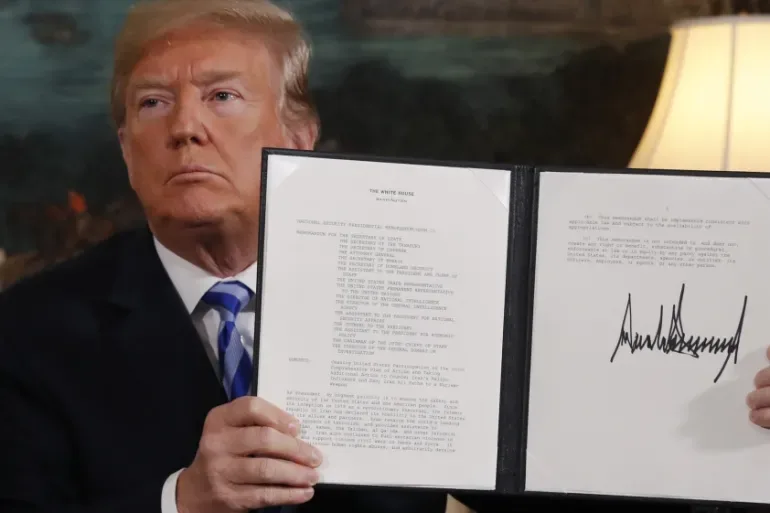
Another major turning point came in May 2018, when US President Donald Trump withdrew the United States from the Joint Comprehensive Plan of Action (JCPOA), the nuclear agreement negotiated between Iran and world powers.
The agreement placed restrictions on Iran’s nuclear activities in exchange for sanctions relief. The International Atomic Energy Agency had reported that Iran was implementing its nuclear-related commitments under the agreement at the time of the US withdrawal.
Washington subsequently reimposed sanctions and pursued a broader set of demands concerning Iran’s nuclear programme, missiles and regional activities.
For Tehran, the withdrawal strengthened the argument that a US administration could abandon an agreement even after Iran had accepted restrictions and international monitoring.
For Washington, concerns about the limits of the original agreement and Iran’s wider regional conduct remained central to the debate over what a future settlement should contain.
The result was a lasting disagreement over the credibility of diplomatic commitments. Iran increasingly sought stronger guarantees against another withdrawal, while US policymakers continued to demand verifiable restrictions before granting substantial economic relief.
Why the two sides cannot agree on who moves first
According to Zweiri, the present negotiations are caught in a cycle in which each government wants the other to demonstrate good faith before making its own concessions.
The United States has sought restrictions on Iran’s nuclear programme, including uranium enrichment, alongside measures to improve security and reopen the Strait of Hormuz.
Iran, meanwhile, has sought relief from sanctions and the US naval blockade, as well as assurances that a new agreement would not be followed by renewed attacks.
These positions create a sequencing problem.
Washington worries that easing pressure before Iran implements its commitments could weaken its negotiating leverage. Tehran worries that making concessions first could leave it exposed if sanctions remain in place or hostilities resume.
Even when negotiators narrow their differences over the substance of a proposal, disagreement over the order and verification of steps can prevent implementation.
The problem is therefore not simply whether the two governments can draft terms that appear acceptable on paper. It is whether either side believes the other will deliver its promised benefits after the first concessions have been made.
The failed Islamabad memorandum
The Al Jazeera analysis identifies a memorandum of understanding signed in Islamabad on June 18 as a particularly important attempt to bridge the divide.
According to the author, the arrangement addressed concerns on both sides. It reportedly linked restrictions on Iran’s enriched uranium stockpile to the prospect of sanctions relief and the release of frozen funds.
It also included provisions concerning the end of hostilities, respect for sovereignty, implementation monitoring and approval of a final agreement by the United Nations Security Council.
However, the arrangement collapsed within days.
Zweiri says Tehran subsequently suspended participation in a Geneva round of talks because a ceasefire in Lebanon had not been secured. From Iran’s perspective, the failure to achieve that condition reinforced doubts about Washington’s ability or willingness to ensure that wider regional commitments were respected.
The episode illustrates a central weakness in negotiations involving multiple actors and conflict zones: an agreement between Washington and Tehran may depend on developments involving other governments and armed groups that neither side can necessarily control directly.
A diplomatic document can contain commitments, but those commitments may not be enough if the parties disagree about what constitutes compliance or whether one side has fulfilled its obligations.
The Strait of Hormuz has become central to the dispute
The negotiations now involve a strategic waterway with major consequences for international energy markets.
The Strait of Hormuz connects the Persian Gulf with the Gulf of Oman and the wider ocean routes. Before the conflict, it carried a substantial share of global seaborne oil trade and liquefied natural gas shipments.
Iran has linked reopening the strait to demands concerning sanctions, the naval blockade and a broader cessation of hostilities. The United States has pressed for the waterway to reopen while also demanding action on Iran’s nuclear programme.
A Reuters report published on October 18 said Iran was urging Washington to accept a proposal under which the strait could be reopened within seven days, subject to Tehran’s conditions. Those conditions included lifting the US blockade on Iranian ports, ending sanctions on Iranian oil exports and halting regional hostilities. Washington, meanwhile, continued to insist that Iran’s nuclear programme be addressed.
The two positions reveal the immediate practical problem: each side wants an important security or economic objective achieved before it makes the concessions sought by the other.
For international markets, prolonged uncertainty over maritime access can increase shipping costs and insurance premiums, disrupt deliveries and make energy prices more volatile. Countries that depend heavily on imported fuel may face higher costs even when they are not directly involved in the conflict.
Have the two sides moved closer to an agreement?
Zweiri argues that the substantive gap between the two sides has narrowed compared with earlier negotiations, even as the trust deficit has deepened.
His assessment suggests that the dispute has increasingly shifted from the broad objectives of an agreement to the order in which its provisions would be implemented.
The United States wants verifiable nuclear restrictions and the reopening of the strait. Iran wants relief from economic and military pressure and stronger guarantees against renewed conflict.
Yet the narrowing of differences over proposed terms does not automatically mean that a settlement is close. The parties must still agree on verification, the timing of sanctions relief, maritime arrangements, the scope of any ceasefire and the consequences of alleged violations.
A deal that is technically possible may remain politically unacceptable if either government believes that implementing it first would leave it vulnerable.
Why a third-party guarantor may matter
Zweiri concludes that a workable agreement may require a third party capable of helping guarantee that both sides implement their commitments in parallel.
Such a mechanism could, in principle, establish a monitored sequence in which specific Iranian actions and corresponding US measures occur together or within clearly defined time limits.
Possible components of a framework could include:
- Phased implementation: Nuclear restrictions, sanctions relief and maritime measures would be tied to agreed milestones.
- Independent verification: Relevant international monitors would assess whether specified obligations had been met.
- Clear dispute procedures: The parties would have a defined process for addressing allegations of non-compliance before a disagreement automatically collapses the entire agreement.
- Credible guarantees: The arrangement would set out what happens if either side withdraws, delays implementation or resumes hostilities.
- Regional coordination: Issues involving Lebanon and other regional theaters would need to be addressed sufficiently to prevent developments outside the core agreement from repeatedly undermining it.
These are potential elements of a negotiating framework, not confirmed terms of a new agreement. Any proposed guarantor would also need sufficient international support and practical influence to make its assurances credible.
What the negotiations mean for the global economy
The diplomatic impasse is not only a security issue. It also affects economic decisions around the world.
Energy companies, shipping operators and governments must plan for the possibility that the conflict could continue disrupting supplies. Businesses may face higher insurance costs, more expensive transport and uncertainty over the availability of fuel and industrial inputs.
For developing economies, the effects can be particularly difficult when higher import bills coincide with currency pressure, limited public finances and existing cost-of-living challenges.
Nigeria is among the countries that need to monitor both international oil-market developments and domestic conditions. Higher crude prices can increase export revenue under certain circumstances, but they do not automatically reduce the costs of fuel, transportation, electricity or food for Nigerian households.
The net effect depends on factors including domestic supply, refining capacity, exchange rates, public spending and the way international prices are transmitted through local markets.
A diplomatic settlement could reduce some of these risks, but its economic benefits would depend on whether shipping and energy production actually return to more predictable conditions.
Factful24 Analysis
The Al Jazeera article presents a useful explanation for why negotiations can fail even when both parties have reasons to prefer an agreement over continued conflict.
The historical record helps explain the mistrust. The 1953 coup, the 1979 hostage crisis and the US withdrawal from the 2015 nuclear agreement are documented events that continue to shape the political context. However, the claim that these events are the principal reason for every negotiating failure is the author's interpretation, not an independently established explanation accepted by all parties.
Other factors also matter: competing security objectives, domestic political pressures, the future of Iran's nuclear programme, regional alliances, sanctions enforcement and the difficulty of securing compliance across multiple conflict zones.
The central diplomatic challenge is that trust cannot simply be demanded from either side. It has to be supported by an arrangement that makes compliance observable and provides consequences for violations.
A staged agreement could help reduce the risk of one party making irreversible concessions while the other delays its obligations. But no mechanism can eliminate every risk, particularly when regional hostilities involve actors beyond the direct control of the negotiators.
The immediate question is whether Washington and Tehran can agree on a sequence that addresses their security concerns without requiring either side to rely solely on the other’s assurances.
Summary:
US–Iran negotiations are being obstructed by more than a disagreement over nuclear restrictions or the Strait of Hormuz. They are also shaped by competing historical experiences, conflicting security priorities and a lack of confidence that promises will be honored.
The failure of previous initiatives shows why a new agreement would need more than carefully worded commitments. It would require clear implementation stages, credible monitoring, a mechanism for resolving disputes and a plan for responding to renewed hostilities.
For the wider world, the consequences are tangible: uncertainty over diplomacy can prolong risks to energy supplies, shipping, trade and the cost of living.
Whether a settlement becomes possible will depend on the choices made by the parties and on whether they can construct a framework in which reciprocal action is more credible than unilateral promises.
Source:
Al Jazeera - Why Iran-US negotiations keep failing, by Mahjoob Zweiri
Editorial note: The main analysis is based on an opinion article. Interpretations of the motives behind US and Iranian negotiating positions are attributed to the author; current diplomatic claims are attributed to the reporting sources.