

United States | News
Rubio Denies US Suspended Intelligence Sharing with Ukraine as Tensions with Zelenskyy Grow
WASHINGTON, October 19, 2026
Washington disputes Kyiv’s account of an intelligence interruption, adding to uncertainty over US support for Ukraine as Russia continues its attacks.
US Secretary of State Marco Rubio has rejected Ukrainian President Volodymyr Zelenskyy’s claim that Washington temporarily interrupted intelligence sharing with Kyiv, exposing another point of disagreement between the two governments as Russia’s war against Ukraine continues.
Speaking to reporters during a visit to Uzbekistan on Monday, Rubio insisted that the United States had not suspended intelligence sharing with Ukraine.
“There has been no pause,” Rubio said, disputing Zelenskyy’s account and arguing that the priority should be ending the war.
His comments followed an interview in which Zelenskyy said American intelligence support had been interrupted for a period before being restored. The Ukrainian president expressed gratitude for the resumption of what he described as critical assistance in defending the country against Russian missile attacks.
The conflicting statements have raised questions about the continuity of intelligence cooperation between Washington and Kyiv at a time when Ukraine remains heavily reliant on Western support to detect and respond to incoming attacks.
Zelenskyy says intelligence support was interrupted and restored
In an interview with NBC’s Meet the Press, Zelenskyy said intelligence sharing had been blocked temporarily before the American side restored it.
The Ukrainian president described the information as particularly important for detecting Russian ballistic missile launches, which can leave defenders with limited time to respond.
Ukraine has repeatedly depended on intelligence supplied by the United States and other Western partners to anticipate attacks, assess threats and coordinate its air defences.
Zelenskyy said Ukraine had experienced periods when warnings about incoming ballistic missile attacks were not received, increasing concern over the reliability of the support available to its military.
The Ukrainian account is significant because intelligence cooperation is not merely a diplomatic arrangement. It can influence how quickly military authorities identify an incoming threat, alert civilians and deploy defensive systems.
However, Zelenskyy’s public statement and Rubio’s denial do not establish precisely what information was shared, when it was shared or whether any particular intelligence channel experienced a temporary interruption.
Rubio rejects the claim
Rubio’s response was direct. He denied that the United States had paused intelligence sharing and redirected attention towards the administration’s stated objective of ending the conflict.
The disagreement leaves two contrasting public accounts on the record.
Kyiv says intelligence support was interrupted and subsequently restored. Washington says there was no pause.
Neither statement, by itself, provides a complete technical account of intelligence delivery during the period in question. Intelligence cooperation can involve different types of information and delivery channels, and a disagreement over a particular warning or capability does not necessarily establish that every form of intelligence sharing stopped.
The distinction matters because the consequences of a genuine interruption could be serious, while an incomplete or delayed warning may have several possible explanations. A definitive assessment would require more detailed information about the specific incidents and the intelligence arrangements involved.
Why US intelligence matters to Ukraine’s defense
Ukraine has relied on American intelligence capabilities to help identify threats from Russian missiles and drones. Such support can help Ukrainian authorities assess launch activity, track potential targets and make decisions about air-defense deployments.
One area of concern involves Star shield, the military-grade satellite communications system associated with SpaceX’s Starlink technology. It is important to distinguish this communications capability from intelligence sharing itself: they are related elements of military support, but they are not interchangeable.
Recent reports about uncertainty surrounding Ukraine’s access to Star shield have added to concerns about Kyiv’s dependence on systems controlled by American companies and subject to US government decisions.
The Washington Post reported on October 14 that Ukrainian officials had been alarmed by uncertainty over both intelligence support and restrictions affecting satellite services. Reuters also reported on October 17 that concerns about intelligence, satellite access and Washington’s wider policy towards Russia had intensified the dispute between the US and Ukrainian leadership.
The developments highlight the strategic risks for a country whose wartime defense depends partly on external intelligence, communications and weapons supplies.
Trump’s policy towards Russia adds to the dispute
The intelligence disagreement comes amid broader friction between US President Donald Trump and Zelenskyy over how to end the war.
Trump has criticized Ukrainian strikes on Russian energy infrastructure, arguing that they contribute to higher fuel prices. His administration has also defended decisions to ease certain sanctions affecting Russian fuel supplies while pursuing negotiations aimed at ending the conflict.
Zelenskyy has argued that such measures could weaken pressure on Moscow and undermine Ukraine’s ability to resist Russian attacks.
On October 19, Al Jazeera reported that Trump defended the decision to waive some sanctions on Russia, saying he did not want to take steps that could drive Moscow away from negotiations. The administration has presented a negotiated settlement as its objective, while Ukrainian officials have continued to stress the need for reliable security support.
The disagreement reflects competing concerns. Washington is seeking to influence the course of negotiations and manage the economic consequences of the conflict, while Kyiv is concerned that reducing pressure on Russia could leave Ukraine more vulnerable.
These differences do not, on their own, prove that the United States has abandoned Ukraine. They do, however, illustrate the uncertainty surrounding the future shape and conditions of American assistance.
Russia continues attacks as Ukraine seeks warning support
The diplomatic dispute is unfolding while Russian attacks continue to threaten Ukrainian cities and infrastructure.
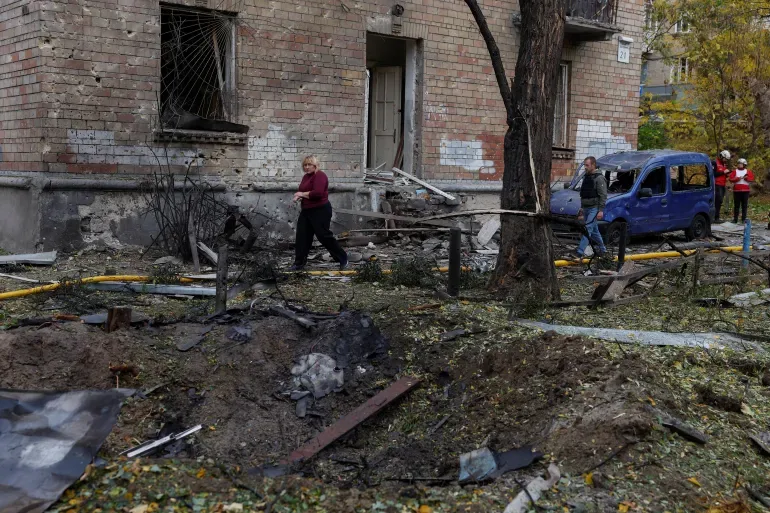
Al Jazeera reported on October 19 that a Russian missile attack killed a woman and wounded several people in Kyiv overnight, according to the city’s mayor, Vitali Klitschko. The attack also damaged buildings, including a metro station, a medical facility and an educational institution, according to Ukrainian emergency services.
The reported attacks underline why the timing and reliability of warnings matter. Early information about ballistic missile launches can help authorities activate defensive systems and alert residents to seek shelter.
Nevertheless, the absence of a warning in a particular incident does not by itself prove that intelligence sharing has been suspended. Establishing the cause would require information about what was detected, what was communicated and when the relevant warning systems received it.
The distinction is especially important in a conflict where military operations, technical limitations and diplomatic disagreements can all affect the information available to the public.
Could the dispute weaken Ukraine’s negotiating position?
The uncertainty surrounding American support has potential implications for Ukraine’s diplomatic position.
If Kyiv believes that essential intelligence or military capabilities could be restricted, it may have to plan for scenarios in which less assistance is available. Such uncertainty can complicate military planning and raise questions about the durability of any future security guarantees.
For Washington, public disagreement with Kyiv risks undermining confidence in the relationship at a moment when the administration is trying to promote negotiations.
Russia, meanwhile, may closely monitor any signs of disagreement among Ukraine’s international partners. However, it would be premature to conclude that the latest exchange will directly determine the course of the war or the outcome of negotiations.
The immediate issue is whether the two governments can clarify what happened, maintain operational cooperation and prevent public disputes from creating additional uncertainty about support for Ukraine.
Factful24 Analysis
The significance of Rubio’s denial lies in the gap between Washington’s account and Kyiv’s description of events.
Zelenskyy says intelligence sharing was interrupted and later restored; Rubio says there was no pause. These claims should not be treated as equivalent to independently verified findings. The public information available so far does not fully establish the timing, scope or cause of the alleged interruption.
It is also important to separate three related but distinct questions: whether intelligence information was shared continuously, whether Ukraine received particular warnings in time, and whether access to satellite communications or other military capabilities was restricted.
A problem in one area does not automatically prove a breakdown in all the others.
The wider political context makes clarification particularly important. Washington and Kyiv have disagreed over attacks on Russian energy infrastructure, sanctions policy and the terms of a possible settlement. Against that background, uncertainty over intelligence cooperation can carry consequences beyond the technical operation of military systems.
A credible assessment will require more than conflicting public statements. Relevant evidence would include a clearer timeline of the alleged interruption, confirmation of which intelligence channels were affected, and an explanation of whether any missed warnings were connected to changes in US policy.
Summary:
Marco Rubio has denied that the United States paused intelligence sharing with Ukraine, while Volodymyr Zelenskyy says support was temporarily interrupted and later restored.
The disagreement remains unresolved in the public record. What is clear is that intelligence and communications support are important to Ukraine’s ability to detect and respond to Russian attacks, and uncertainty over those capabilities can affect military planning and diplomatic confidence.
The next key development will be whether Washington and Kyiv provide further clarification and demonstrate that their cooperation remains reliable as efforts to end the war continue.
Sources:
Reuters - Rubio denies US paused intelligence sharing with Ukraine, October 19, 2026
Editorial note: This report distinguishes statements made by US and Ukrainian officials from independently established facts. The precise scope and timing of the alleged interruption have not been conclusively established in the cited public reporting.