

Education
BREAKING: Enugu College Mandates NELFUND Loan Applications, Threatens Exam Restrictions for Non-Compliance
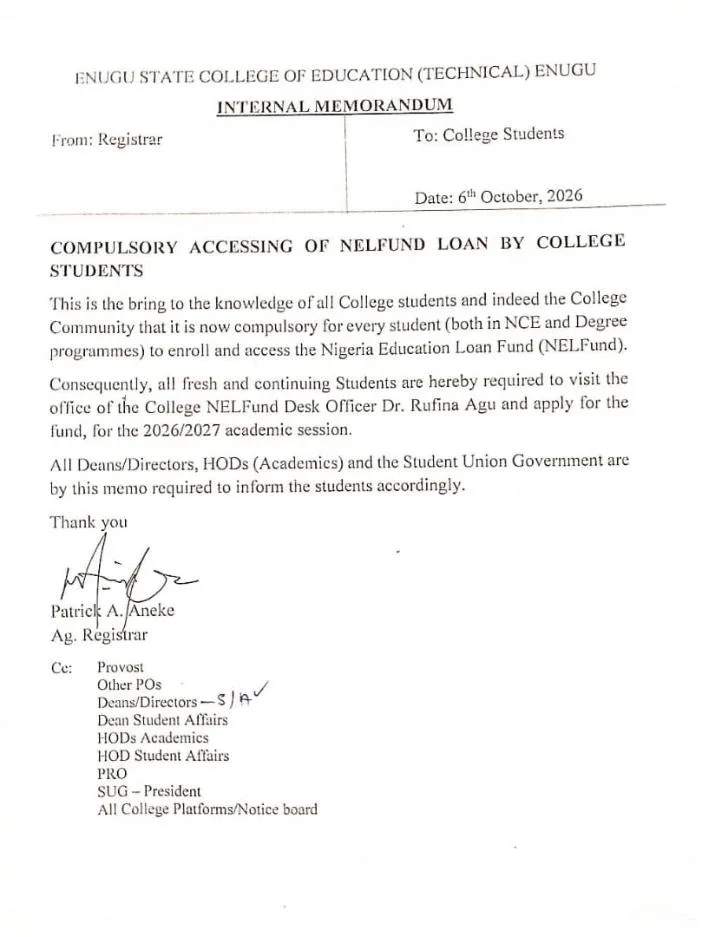
A controversial directive at the Enugu State College of Education (Technical), Enugu (ESCET), has drawn public outrage after a leaked internal memo and WhatsApp messages suggested that the institution is forcing students to enroll for the Federal Government’s Nigeria Education Loan Fund (NELFUND) and threatening to keep them from exams if they refuse.
Instructions for mandatory enrollment
An internal memorandum reportedly obtained by SaharaReporters shows that ESCET management required all students—whether on the Nigeria Certificate in Education (NCE) or degree programme—to enroll for and access the NELFUND loan for the 2026/2027 academic session. The memo dated October 6, 2026 was signed by the Acting Registrar, Patrick A. Aneke.
It instructed fresh and returning students to visit the College NELFUND Desk Officer, Dr. Rufina Agu, to apply for the fund. It directed deans, directors, heads of academic departments, and the Student Union Government to inform students accordingly.
Threat to examination clearance
The directive caused alarm in a WhatsApp group used for college information where the Dean of Students Affairs, Dr. Bertrand Ekwe, identified in the chat as “Dr. @Sing Hu,” supposedly confirmed that a NELFUND registration receipt had become a condition for examination clearance.
When a student asked what would happen if their parents refused to allow them to take the loan, the account associated with the dean allegedly replied that continuing at ESCET “might be very difficult.” When the student asked whether they would be kept from writing examinations without a NELFUND receipt, the reply was: “Yes for now or if management change their decision.
Free-speech concerns
The WhatsApp messages also raised concerns about the right to dissent. When a member objected to forcing uninterested students to apply for the loan, the account linked to the dean reportedly warned the person not to “discourage others” and threatened removal from the platform if they continued to criticize the memo. Some students alleged that the policy served interests beyond student welfare. One message circulating in the group claimed that fees displayed on students’ NELFUND dashboards had been inflated above the normal school-fee amount, though the allegation was not independently verified in the report.
Students request policy review
Students affected are now calling on the management to review the directive and allow students who do not want the federal loan to pay their fees directly and continue their studies without obstruction. They argue that NELFUND was designed as a support mechanism for financially disadvantaged students, not a compulsory condition for academic participation
What the law provides
The Students Loans (Access to Higher Education) (Repeal and Re-Enactment) Act, 2024 established NELFUND to provide loans to qualified Nigerians for tuition, fees, charges, and upkeep in approved public tertiary institutions and licensed vocational or skills-acquisition institutions. Unlike the repealed 2023 law, which restricted eligibility to indigent students from families earning below ₦500,000 annually, the 2024 Act removed that income cap and broadened access to all qualified Nigerian students in eligible public institutions.
However, the law’s stated objective remains expanding access to higher education and easing financial barriers—not making loan uptake compulsory. Official communications continue to encourage students facing financial stress to prioritize the scheme so that they are not forced out of school.
Source: saharareporters