

United States | News
Trump’s Role Dominates Michigan Senate Race as Mike Rogers Breaks with GOP Line on Key Policies
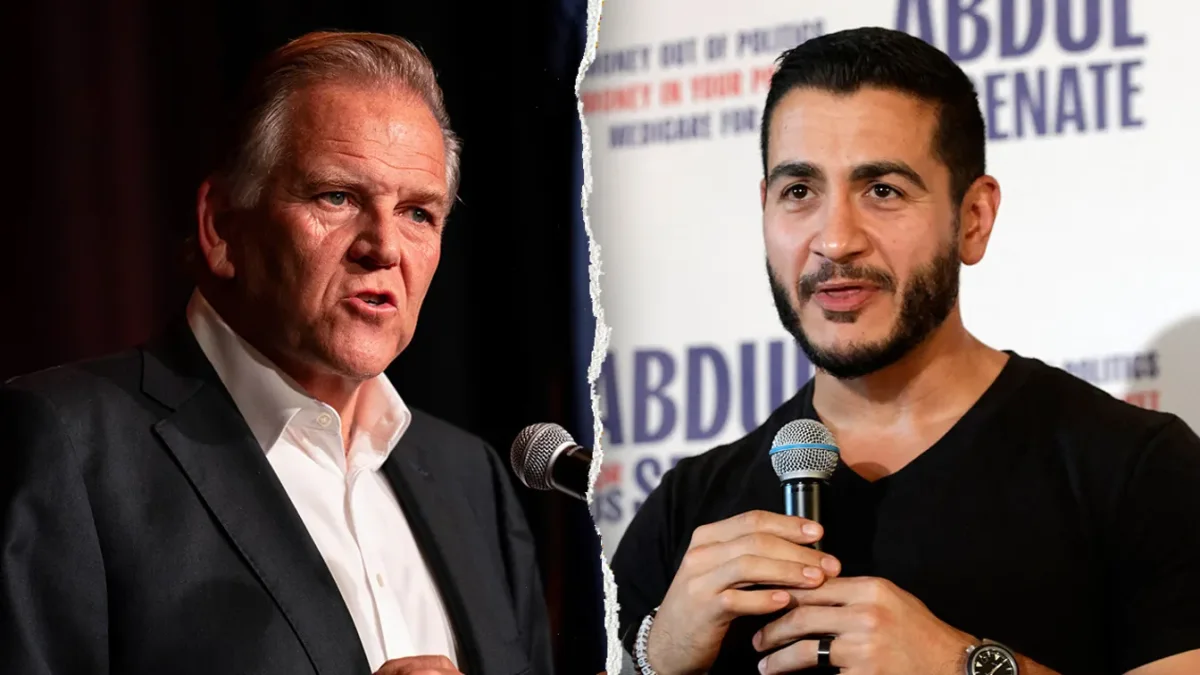
The central issue in the developing Michigan Senate contest is the influence of President Donald Trump on Republican candidate Mike Rogers, as Democratic challenger Abdul El-Sayed seeks to make the president’s policies a defining issue in the campaign.
The dispute reflects a broader challenge facing Republicans in the 2026 midterm elections: maintaining support from Trump’s political base while responding to voters concerned about the economy, trade tariffs and the cost of living. Rogers has continued to align himself with Trump on several issues but has also publicly challenged the administration’s approach to tariffs on Canada.
Trump Becomes Central Figure in Michigan Senate Showdown
President Donald Trump emerged as a central figure in the latest Michigan Senate debate, as Democratic candidate Abdul El-Sayed repeatedly linked Republican rival Mike Rogers to the president’s policies while Rogers defended his record and challenged his opponent’s political positions.
The debate, held on Wednesday, October 21, came as both candidates intensified their campaigns for an open U.S. Senate seat ahead of the November 2026 midterm elections.
According to Fox News, El-Sayed mentioned Trump 18 times during the hour-long exchange and repeatedly used the phrase “MAGA bingo” to criticize what he described as Rogers’ reliance on Trump-aligned political talking points.
Rogers responded by turning the criticism around, suggesting that El-Sayed’s repeated references to Trump had become a campaign strategy of their own.
The exchange underscored the importance of the president’s influence in a state where the candidates are competing over economic concerns, national security, immigration and the direction of American foreign policy.
Rogers Distances Himself from Trump on Trade
Despite his support for Trump, Rogers signaled disagreements with the president’s trade policies, particularly tariffs imposed on Canada.
Rogers described Trump’s tariffs as a “mixed bag” and suggested that the measures targeting Canada might not have been properly considered.
His position marks a distinction between his broader alignment with the administration and his approach to trade with a neighboring country that plays a significant role in Michigan’s economy.
Michigan has extensive economic connections with Canada, particularly in the automotive industry, manufacturing and cross-border supply chains. Trade restrictions can therefore affect businesses and workers on both sides of the border.
Rogers’ comments also follow his earlier calls for an end to the tariff dispute with Canada, a position he has presented as necessary to protect Michigan’s economic interests.
For El-Sayed, the disagreement offers an opportunity to question whether Rogers would consistently challenge Trump when presidential policies conflict with the interests of Michigan residents.
Chinese Automakers Become Another Point of Disagreement
The candidates also disagreed over whether Chinese automobile manufacturers should be permitted to build vehicles in the United States.
Rogers argued that Congress should prohibit Chinese automakers from manufacturing vehicles on American soil.
El-Sayed countered by pointing to Trump’s previously expressed openness to Chinese companies building vehicles in the United States, questioning whether Rogers would oppose the president if the administration pursued that approach.
The disagreement carries particular significance in Michigan, where the automotive sector remains an important source of employment and economic activity.
The debate over Chinese vehicle production touches on several competing concerns, including domestic manufacturing jobs, foreign investment, national security, competition and the future of the American automobile industry.
The candidates’ positions illustrate how disagreements over trade and manufacturing can emerge even among politicians who share some broader economic or political priorities.
Healthcare, Immigration and Economic Policies
Beyond Trump and trade, the contest reflects a wider divide over the role of the federal government.
El-Sayed, a physician and former Detroit public health official, has campaigned on a progressive platform that includes Medicare for All, higher taxes on wealthy Americans, ending U.S. military assistance to Israel and abolishing Immigration and Customs Enforcement, commonly known as ICE.
Rogers, a former congressman, has sought to portray El-Sayed’s proposals as too far-reaching, arguing that his rival’s policies would expand government and increase the tax burden.
Rogers has also challenged El-Sayed over his past comments on policing, immigration and political associations.
El-Sayed, in turn, has focused on the cost of living and argued that Rogers would largely support the Trump administration’s agenda in the Senate.
These competing arguments reflect the candidates’ different approaches to healthcare, taxation, immigration enforcement and the relationship between federal spending and household economic pressures.
Muslim Brotherhood Allegations Fuel Debate Tensions
The debate also featured contentious exchanges over El-Sayed’s political associations and national loyalty.
Rogers repeated allegations linking some of El-Sayed’s supporters and donors to Hamas, Hezbollah and the Muslim Brotherhood. El-Sayed has rejected attacks questioning his loyalty to the United States and condemned the suggestion that his background or political positions make his commitment to the country suspect.
The allegations and counterarguments have become a recurring feature of the campaign, alongside disagreements about the war in Gaza, U.S. support for Israel and the conflict involving Iran.
El-Sayed, who is Muslim and whose parents emigrated from Egypt, has faced scrutiny over his foreign-policy positions and past public statements. His campaign has argued that attacks on his identity and patriotism distract from issues affecting voters.
The claims made during political debates should be distinguished from independently established evidence. Allegations about political associations do not, by themselves, establish wrongdoing by a candidate.
Why Michigan Matters in the 2026 Midterms
Michigan’s Senate contest has attracted national attention because the outcome could affect the balance of power in the U.S. Senate.
The race also highlights a strategic challenge for Republicans: how to maintain support among Trump-aligned voters while addressing concerns about tariffs, prices and the economic consequences of federal policy.
For Democrats, the contest presents an opportunity to connect Republican candidates with the administration’s record while persuading voters that alternative policies would better address their economic and social concerns.
However, the debate also demonstrates that candidates are not necessarily aligned with their parties or political allies on every issue. Rogers’ criticism of Canadian tariffs illustrates how regional economic interests can complicate broader partisan loyalties.
The candidates’ arguments will ultimately be judged alongside their policy proposals, records and responses to voters’ concerns.
Note:
The Michigan Senate contest has become a debate not only about two candidates but also about the influence of Donald Trump on American politics.
El-Sayed is attempting to make the president’s policies a central issue in Rogers’ campaign, while Rogers is challenging El-Sayed’s proposals and drawing distinctions between his own positions and parts of Trump’s trade agenda.
Their disagreement over Canadian tariffs and Chinese vehicle manufacturing highlights a key question for voters: how should elected officials balance party loyalty with the economic interests of their constituents?
As the November midterms approach, the contest offers a closely watched example of how national political divisions, regional economic priorities and questions of public trust intersect in a competitive Senate race.
Additional context: The Washington Post’s analysis of the Michigan Senate debate.