

Crime Related | News
INTERPOL Arrests 1,462 Suspects in Africa-Wide Cybercrime Crackdown, Recovers Over $105 Million
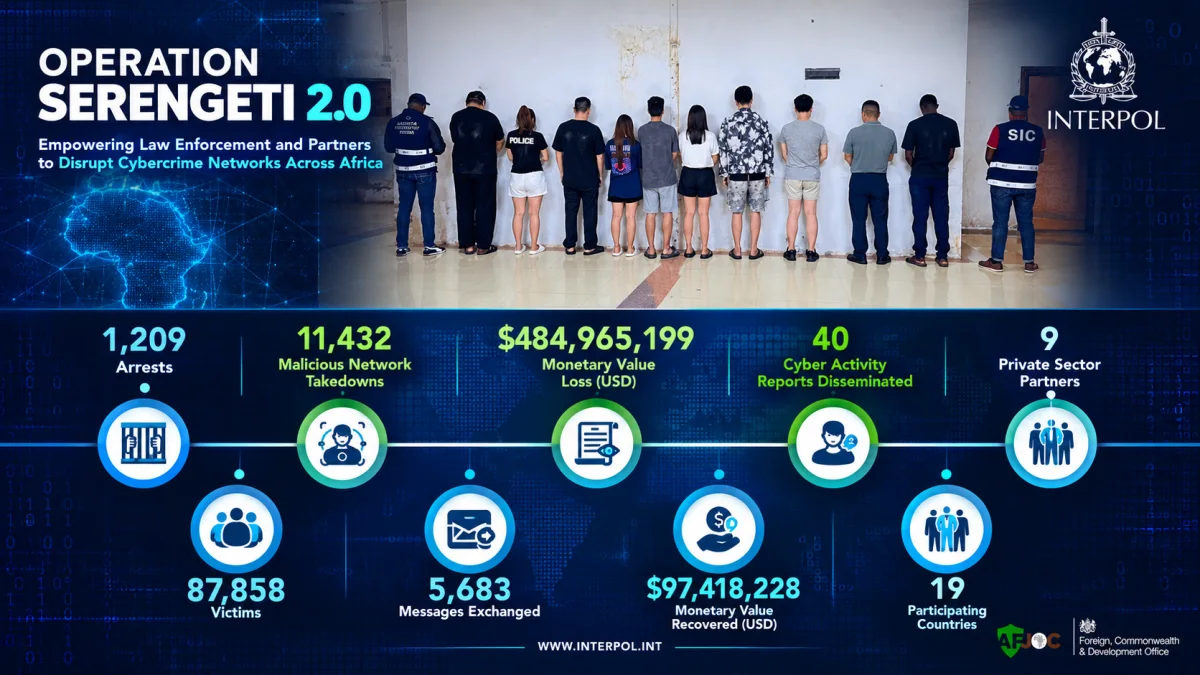
Authorities in 21 countries have arrested 1,462 suspects in a coordinated operation targeting online fraud, ransomware, business email compromise and other cybercrimes across Africa. INTERPOL says the operation also led to the disruption of 10,909 malicious networks and the recovery of more than $105 million in illicit funds.
The operation, known as Serengeti III, ran from 29 June to 31 August 2026 and involved law enforcement agencies from 20 African countries and the United States. Investigators identified 65,929 victims, while financial investigations linked the suspected criminal activities to losses exceeding $385 million.
What Interpol's operation uncovered
According to the reported findings, the crackdown targeted several forms of digital crime, including phishing, investment fraud, fraudulent business communications, ransomware and digital extortion.
INTERPOL said the operation was supported by cybersecurity companies that provided intelligence and technical assistance to help investigators identify suspicious online infrastructure, trace criminal networks and support law enforcement actions.
The findings show that cybercrime operations increasingly cross national borders, with fraudsters exploiting digital platforms to target individuals, pensioners and businesses in different countries.
Nigeria: Investigators uncover phishing and investment fraud
Nigeria featured in two investigations highlighted by INTERPOL.
In one case, authorities arrested a suspect allegedly connected to a large-scale phishing and business email compromise operation. Investigators reportedly found that the operation had collected software login credentials and accumulated approximately 2.1 million email addresses. A luxury vehicle suspected to have been purchased with proceeds from the fraud was also recovered.
In a separate investigation, authorities targeted an international investment fraud scheme promoted through messaging applications. Financial investigations traced more than $2.4 million in suspected criminal proceeds, much of which was reportedly laundered through cryptocurrency transactions. A suspect was arrested in connection with the case.
The cases illustrate how cybercrime can extend beyond individual online scams into organized financial operations involving stolen credentials, fraudulent investment offers and the movement of suspected criminal proceeds.
Uganda, Angola and other countries also affected
The operation uncovered several other alleged criminal activities across the continent.
- Uganda: Authorities dismantled two transnational fraud networks and arrested 365 foreign nationals linked to online investment and pension fraud schemes targeting victims in Asia. Investigators reportedly identified call-center operations using scripted communications, fake trading platforms and fraudulent websites.
- Angola: Authorities dismantled two illegal cryptocurrency mining centers, arrested nine suspects and seized more than 2,000 mining devices, along with six power-transformation stations.
- Tanzania: Investigators dismantled a scheme involving a malicious mobile loan application.
- Gabon: Authorities disrupted a vehicle-import fraud network operating through social media.
- Republic of the Congo: Police arrested 30 suspects linked to a cybercrime operation.
INTERPOL said investigations were continuing, with authorities working to identify additional suspects, trace illicit funds and analyze seized digital evidence.
Growing concern over AI-assisted cybercrime
The crackdown comes amid concerns about the changing cyber threat landscape in Africa. Interpol's 2026 African cyber threat assessment reportedly highlights the growing use of artificial intelligence by cyber criminals to support increasingly sophisticated schemes.
AI-enabled tools can potentially help criminals create convincing fraudulent messages, impersonate legitimate organizations and scale deceptive activities. However, the technology can also support legitimate cybersecurity work, including fraud detection and threat analysis.
For individuals and businesses, the findings reinforce the importance of protecting email accounts, verifying investment opportunities independently, enabling multi-factor authentication and avoiding suspicious links or requests for confidential login details.
Note
The arrests and financial recoveries demonstrate the scale of the challenge facing authorities combating cybercrime across Africa. The reported losses exceeding $385 million also underline the financial damage that digital fraud can cause to victims and businesses.
For Nigeria, the investigations highlight the importance of distinguishing legitimate digital entrepreneurship from criminal activity. Sustainable growth in the technology sector depends on public trust, secure digital transactions and effective enforcement against fraud.
The cases remain subject to the relevant legal processes. Being arrested or suspected of cybercrime does not, by itself, establish guilt.
Sources and verification
- BBC News Pidgin — Original report on the arrests.
- INTERPOL — details corroborated through reporting by cybersecurity partner Group-IB and other news organizations.