

News
FG Commissions 81km Abuja–Kaduna Highway Section, Umahi Says Project Took 13 Months
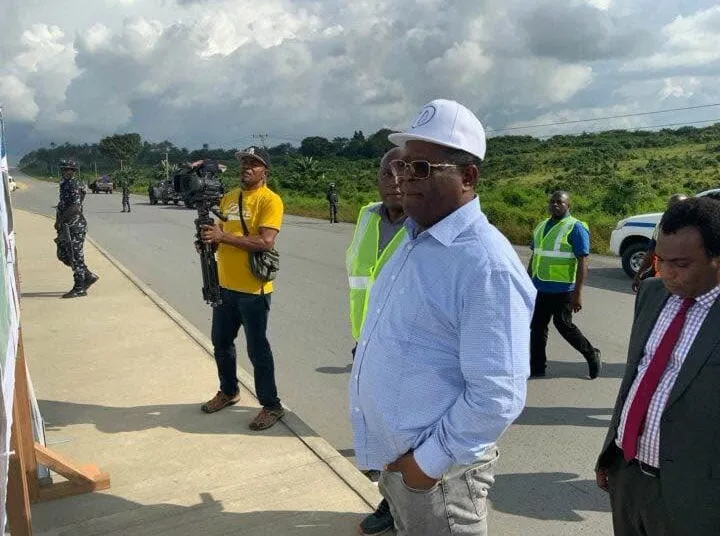
The Federal Government says it has completed an 81-kilometre section of the Abuja–Kaduna highway in 13 months, with the Works Minister, David Umahi, highlighting the use of reinforced concrete pavement and outlining further work on the wider Abuja–Kaduna–Zaria–Kano corridor.
The Federal Government has commissioned an 81-kilometre section of the Abuja–Kaduna highway, with Minister of Works David Umahi saying the project was completed within 13 months under President Bola Tinubu’s administration.
President Tinubu inaugurated the road section in Kaduna State on Saturday, October 24, 2026, during activities associated with the All Progressives Congress (APC) presidential campaign flag-off ahead of the 2027 general election.
According to a report by Leadership, Umahi described the pace of construction as the fastest road project completion in Nigeria’s history. He compared the development with what he said was the completion of 240 kilometers of the highway over eight years under previous administrations using asphalt pavement.
The minister’s assessment reflects the government’s position on the project’s delivery timeline. However, the wider impact of the reconstruction will depend on road quality, maintenance, safety and the experience of motorists using the route.
Project Cost and Construction Method
Umahi said the commissioned 81-kilometre stretch forms part of the 118-kilometre first lot of the Abuja–Kaduna–Zaria–Kano highway project.
He disclosed that the first lot was valued at ₦252 billion and that more than 95 per cent of the contract sum had been paid.
The government adopted reinforced concrete pavement for the reconstruction after taking over the project, according to the minister. The approach is intended to provide a durable road surface capable of withstanding heavy traffic.
The project is part of a broader effort to improve a major transport corridor connecting Abuja with Kaduna, Zaria and Kano. The route serves passengers, commercial vehicles and businesses transporting goods between the Federal Capital Territory and important northern commercial centers.
The reported completion of the 81-kilometre section represents a significant milestone in the project. Nevertheless, assessing its overall value requires consideration of the total contract expenditure, construction standards, delivery milestones and long-term maintenance obligations.
Work Continues on the Remaining Highway Sections
Umahi also provided an update on the second section of the highway, which covers 164 kilometers and was valued at ₦505 billion.
He said more than 144 kilometers had been completed, expressing confidence that the remaining portion would be finished by the end of November 2026.
The minister further disclosed that President Tinubu had directed the installation of solar-powered streetlights along the entire 375-kilometre Abuja–Kaduna–Zaria–Kano highway.
Such lighting could improve nighttime visibility for motorists, although its practical safety benefits will depend on complete installation, reliable operation and maintenance.
The government has also reported work on additional sections around the Chere-Zero area towards Kogi State and near the Aminu Kano International Airport.
Wider Road Construction Programme
Beyond the Abuja–Kaduna highway, Umahi said the Federal Government had completed 348 kilometers of roads in the North-West out of 1,016 kilometers reportedly completed nationwide.
He added that approximately 1,800 kilometers of roads in the North-West had been partially completed, while 4,083 kilometers of road projects were ongoing across the region.
According to the minister, the projects form part of a nationwide road construction portfolio covering approximately 17,000 kilometers.
He also discussed the Sokoto–Badagry Superhighway, a proposed 1,068-kilometre transport corridor. Umahi reported ongoing construction activity in Kebbi and Sokoto states, putting progress in Sokoto at 60 per cent.
These figures were presented by the minister and should be understood as government-reported project updates.
What the Project Means for Motorists and Businesses
The Abuja–Kaduna–Zaria–Kano corridor is important to the movement of people, agricultural produce, manufactured goods and other commercial supplies across northern Nigeria.
Improved road conditions could reduce vehicle damage, support more predictable journeys and improve connections between commercial centers. The benefits, however, will depend on the condition of the completed sections and the progress made on unfinished portions of the highway.
For motorists, the key questions include whether the road remains in good condition, whether construction-related disruptions decline and whether the promised street-lighting becomes fully operational.
For taxpayers, transparency around contract costs, payments, completion certificates and maintenance plans will remain important in determining the project’s overall performance.
Political Context and Public Accountability
The commissioning took place alongside APC campaign activities in Kaduna ahead of the 2027 general election, placing the infrastructure announcement within a wider political context.
The administration has presented road construction as part of its development programme, while Umahi has argued that the pace of work demonstrates the benefits of the government’s chosen construction approach.
The public assessment of the project should nevertheless extend beyond the commissioning ceremony. Independent verification of completed kilometers, engineering quality, expenditure and long-term road performance would help establish how effectively public resources have been used.
The distinction between the 81 kilometers commissioned and the wider 118-kilometre first lot is also important: the commissioned stretch should not automatically be described as the entire first lot.
Note:
The commissioning of the 81-kilometre Abuja–Kaduna highway section marks a reported milestone in the Federal Government’s reconstruction programme. The government has also announced further progress on the wider highway corridor and plans for solar-powered street lighting.
The longer-term test will be whether the road delivers sustained improvements in safety, travel conditions and commercial transportation—and whether the remaining sections are completed within their announced timelines.
Source: Leadership Newspaper - Federal Govt Completed 81km Abuja-Kaduna Highway Section In 13 Months – Umahi