

News
Subsidy Removal: Tinubu Chose to Confront Economic Challenges Rather Than Pass Them to Next Generation, Minister Says
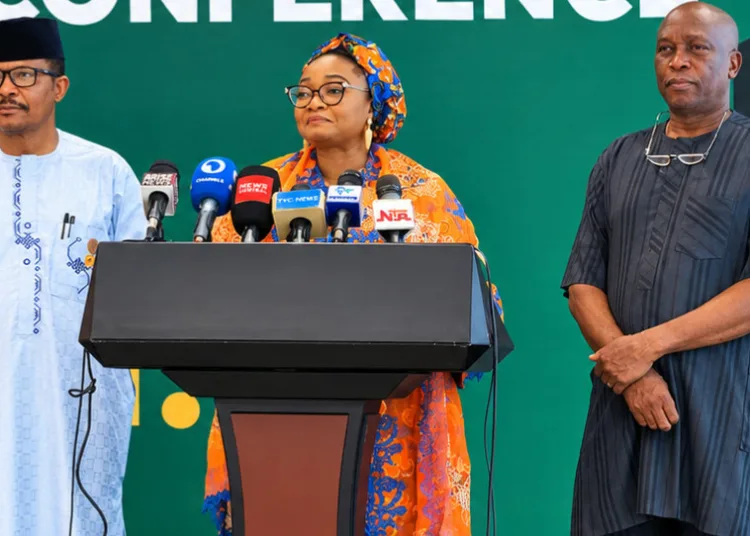
Nigeria’s Minister of Women Affairs and Social Development, Imaan Sulaiman-Ibrahim, has defended President Bola Tinubu’s economic reforms, arguing that the administration chose to address longstanding economic challenges instead of leaving them for future generations.
The minister made the remarks in Abuja on Tuesday during a press conference ahead of the planned launch of a book examining Tinubu’s reform agenda.
According to Leadership, Sulaiman-Ibrahim said petrol subsidy payments had placed pressure on public finances, limiting resources available for essential services such as education, healthcare and road infrastructure.
She argued that the administration’s decision to remove the subsidy was part of efforts to address structural weaknesses in Nigeria’s economy and public revenue system.
“When Mr. President took the oath of office on 29 May 2023, he inherited hard choices that could no longer wait,” the minister said, defending the government’s approach.
Minister acknowledges hardship faced by Nigerians
Sulaiman-Ibrahim acknowledged that the reforms had imposed significant financial pressure on Nigerian households but maintained that the government believed the measures were necessary.
She said the administration was beginning to see what it considered encouraging signs, including stronger external reserves, easing inflation and renewed investor confidence.
However, the minister recognized that the expected benefits of the reforms might not immediately translate into improved living conditions for every Nigerian.
She urged patience with implementation while emphasizing the importance of ensuring that government policies deliver measurable benefits to ordinary citizens.
Government highlights tax reforms and education support
The minister identified the Nigerian Education Loan Fund (NELFUND), new tax laws and financial autonomy for local governments as measures intended to broaden access to opportunities and improve public service delivery.
She said the education loan scheme was helping students from less privileged backgrounds pursue higher education, while the tax reforms were designed to reduce excessive burdens on low-income earners and small businesses.
Sulaiman-Ibrahim also argued that financial autonomy for local governments could bring public resources closer to communities and support development at the grassroots level.
On education, she highlighted early childhood learning, science and technology education, and technical and vocational training as important areas for government intervention.
Borrowing and accountability
Addressing the broader question of public borrowing, the minister argued that debt was not necessarily incompatible with economic development, provided borrowed funds were invested productively.
She stressed the need for prudent management of public resources and called for investment in infrastructure and other sectors capable of generating measurable economic returns.
Her comments come amid continuing public debate over the cost of living, fuel prices, taxation and the effects of economic reforms introduced since Tinubu assumed office in May 2023.
While the administration has defended its policies as necessary to correct longstanding economic imbalances, the impact on household purchasing power and the speed at which ordinary Nigerians experience improvements remain important issues in the national debate.
2027 election debate
The minister also urged the media to prioritize factual reporting as political activities intensify ahead of the 2027 general elections.
She expressed confidence in the administration’s reform agenda and said government announcements should be assessed alongside implementation and tangible results.
The remarks were made ahead of the planned unveiling of The Courage to Reform: Architecture of President Bola Ahmed Tinubu, GCFR — Beyond 2027: Statecraft, Vision for National Renewal, a book promoted by the PBAT Door-to-Door Movement.
The event is intended to examine the administration’s policies and achievements, including subsidy removal, tax reforms and education initiatives.
Ultimately, the central question facing the government is whether the economic changes it has defended will translate into sustained improvements in household incomes, employment, public services and living standards across Nigeria.
Source: Leadership Newspaper - Subsidy: Tinubu Could Have Passed Problems to Next Generation But He Confronted Them