

News
Okorocha Challenges Uzodinma’s Electoral Mandate, Says Imo Governor Has Never Won an Election
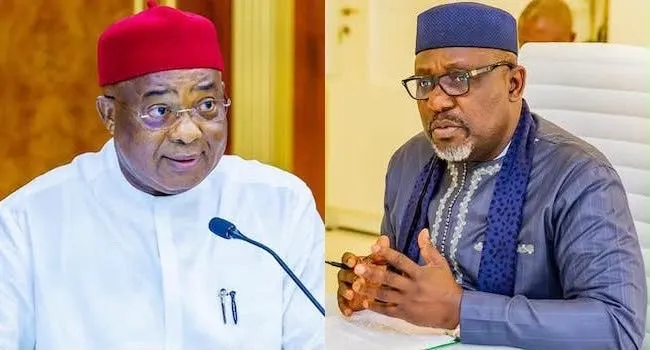
Former Imo State Governor Rochas Okorocha has questioned the electoral legitimacy of his successor, Hope Uzodinma, following a recent court verdict, renewing the political controversy surrounding the circumstances of Uzodinma’s emergence as governor of Imo State.
The remarks have brought renewed attention to the political relationship between the two former allies, the history of Imo State's governorship elections and the role of the judiciary in determining electoral outcomes.
Court Judgment Triggers Fresh Political Confrontation
The controversy followed a judgment delivered on Thursday, October 29, 2026, by the Federal High Court in Abuja, presided over by Justice Obiora Egwuatu.
The court ruled in favor of Okorocha in a legal dispute concerning the All Progressives Congress (APC) senatorial primary for Imo West Senatorial District ahead of the 2027 general elections.
The judgment ordered the APC to submit Okorocha's name to the Independent National Electoral Commission (INEC) as its candidate for the senatorial district. It also directed Uzodinma to stop presenting himself as the party's candidate for the election.
The judge held that the evidence presented before the court established that Okorocha secured the majority of votes in the May 18, 2026, primary and was therefore entitled to the party's nomination.
Reacting to the ruling during an appearance on Channels Television's Politics Today, Okorocha questioned Uzodinma's electoral history, making the controversial declaration:
"Hope has never won an election in his life. Let him take you back. Factually speaking, I can run a real election."
The former governor alleged that Uzodinma's political victories had been associated with the manipulation of election results rather than the genuine reflection of votes cast by the electorate.
He further argued that the latest court decision reinforced his longstanding concerns about the governor's political rise.
These allegations represent Okorocha's personal assessment and have not been established as a general judicial finding concerning every election contested by Uzodinma.
Okorocha Revisits the 2019 Imo Governorship Election
A significant part of Okorocha's argument relates to the controversial 2019 Imo State governorship election, which remains one of the most consequential electoral disputes in the state's political history.
During the election, Emeka Ihedioha of the Peoples Democratic Party (PDP) was initially declared the winner by INEC.
However, Hope Uzodinma, who contested under the APC, challenged the result at the Supreme Court.
In January 2020, the Supreme Court overturned Ihedioha's victory and declared Uzodinma the duly elected governor of Imo State.
The apex court's decision was based on its acceptance that results from 388 polling units had been unlawfully excluded during the collation process. Following the recalculation, the court concluded that Uzodinma had obtained the majority of lawful votes.
He was subsequently sworn in as governor, replacing Ihedioha.
Okorocha has repeatedly questioned the circumstances surrounding that outcome. His latest comments revisit the controversy by arguing that the governor's emergence was not the product of a conventional electoral victory at the polling booths.
However, it is important to distinguish Okorocha's political interpretation from the Supreme Court's binding judgment, which recognized Uzodinma as the elected governor in 2020.
What the Latest Court Ruling Means for Uzodinma's Senate Ambition
Beyond the exchange between the two politicians, the October 29 judgment raises significant questions about the APC's preparations for the 2027 general elections.
Uzodinma had been recognized as the APC candidate for Imo West Senatorial District following the party's May 18 primary.
The dispute arose after Okorocha challenged the outcome, insisting that the official nomination did not reflect the votes recorded during the exercise.
In its ruling, the Federal High Court examined the documentary evidence relating to the primary and identified inconsistencies in the materials submitted to support Uzodinma's nomination.
The court consequently set aside the recognition of Uzodinma and directed the restoration of Okorocha's name.
The dispute is particularly significant because Uzodinma is still serving as Imo State governor, with his current tenure expected to run until January 2028.
The 2027 National Assembly is scheduled to be inaugurated in June 2027, creating a potential constitutional and political complication around the governor's reported senatorial ambition.
The court proceedings also raised questions about Section 183 of the 1999 Constitution, which restricts a sitting governor from holding another executive office or paid employment while in office.
APC Rejects the Political Implications of the Judgment
Despite the court's decision, the APC leadership in Imo State maintained that Uzodinma remained its recognized candidate for the senatorial district.
The party insisted that the governor had won the primary with overwhelming support from party members.
It also announced that its legal department would examine the judgment before determining its next course of action.
This position suggests that the dispute may not be over, particularly if the party decides to challenge the ruling through the appellate courts.
The disagreement has also exposed divisions within the party over the nomination process and the political interests surrounding the 2027 elections.
Political Implications for Imo State and the 2027 Elections
The confrontation between Okorocha and Uzodinma goes beyond a disagreement over a senatorial ticket. It reflects a broader struggle over political influence, party leadership and control of the APC's political structure in Imo State.
Several issues are now attracting attention:
1. The future of Uzodinma's senatorial ambition: The governor's ability to secure the APC ticket will depend on the legal outcome and any subsequent appeals.
2. The position of Rochas Okorocha: The judgment provides him with a judicially recognized claim to the APC nomination, subject to any further legal proceedings.
3. APC internal cohesion: The disagreement could create additional divisions among party stakeholders as preparations for 2027 intensify.
4. The judiciary and electoral accountability: The case has renewed public discussion about the importance of transparent party primaries and compliance with electoral laws.
5. The 2019 election controversy: Okorocha's comments have once again brought the Supreme Court's decision that brought Uzodinma into office under public scrutiny.
Note:
The latest confrontation between Rochas Okorocha and Hope Uzodinma demonstrates how unresolved political rivalries can resurface during critical electoral periods.
Okorocha's declaration that Uzodinma has never won an election is a serious political allegation, particularly given the governor's controversial emergence in 2020 through a Supreme Court judgment.
Nevertheless, the distinction between political accusations and established judicial findings remains important. The Supreme Court recognized Uzodinma as Imo governor in 2020, while the latest Federal High Court judgment concerns the APC's 2026 senatorial primary.
Ultimately, the unfolding dispute raises important questions about internal party democracy, electoral transparency, constitutional provisions and the influence of political power in Nigeria's democratic process.
The next steps in the legal battle could have consequences for the APC's preparations for the 2027 elections and the political balance in Imo State.
Sources and further reading