

Middle East | News
How Can Israel Break Its Election Deadlock? Five Possible Scenarios as Netanyahu Struggles to Secure a Governing Majority
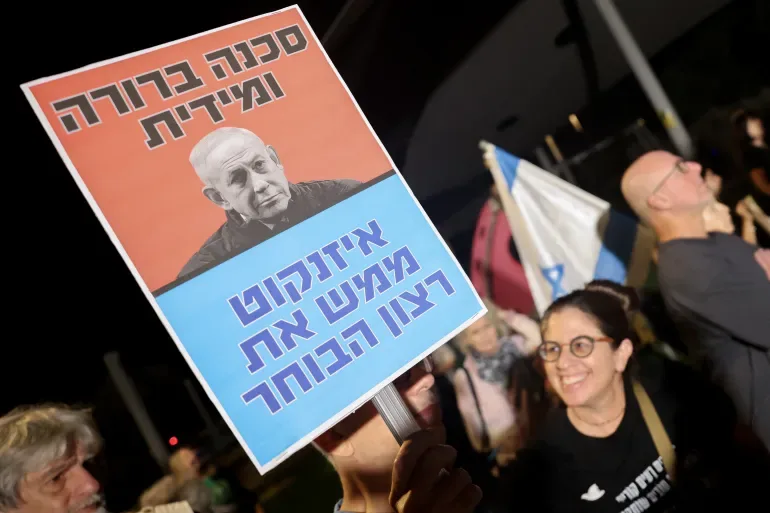
INTERNATIONAL POLITICS | October 30, 2026
Israel is facing another period of political uncertainty following its October 27, 2026, general election, after neither Prime Minister Benjamin Netanyahu's political bloc nor the opposition secured enough parliamentary seats to form a government.
The central problem is the absence of a 61-seat majority in Israel's 120-member parliament, known as the Knesset. The results have placed smaller political parties, particularly Arab political groups, in a potentially decisive position during coalition negotiations.
According to the final results reported by Al Jazeera:
- Benjamin Netanyahu's bloc: 53 seats.
- Opposition bloc led by Gadi Eisenkot: 48 seats.
- United Arab List (Ra'am) and Joint List: 19 seats combined.
- Required majority: 61 seats.
Voter turnout was reported at 77.9 percent, reflecting substantial participation in the election.
Why Is Israel Facing a Political Deadlock?
Israel's parliamentary system requires political parties to negotiate alliances and form coalition governments because no single party has historically secured an outright majority.
Although Netanyahu's bloc emerged with 53 seats, it remains eight seats short of the required majority. The opposition grouping, meanwhile, has 48 seats and would need additional parliamentary support.
The complication is that both Netanyahu and the opposition leadership have ruled out working with the two principal Arab electoral lists, despite their combined 19 seats.
This political disagreement has created a situation in which parties may have enough parliamentary numbers to form a government but lack the political willingness to cooperate with one another.
Five Possible Ways Israel Could Break the Deadlock
1. Formation of a unity government
One possibility is for Netanyahu's Likud party to form a broad coalition with opposition parties, including factions associated with Gadi Eisenkot, Avigdor Lieberman and Naftali Bennett.
Such an arrangement could command approximately 66 seats, giving it a parliamentary majority.
However, this arrangement faces significant political obstacles. Netanyahu's potential partners have campaigned against his continued leadership, while Netanyahu would have to reconsider his reliance on far-right and ultra-Orthodox political allies.
2. An opposition government supported by Arab parties
Eisenkot's opposition bloc could attempt to form a government with the backing of Ra'am and the Joint List.
Together, the opposition and Arab parties have 67 seats, theoretically providing sufficient parliamentary support.
The Arab parties have indicated their willingness to cooperate under certain conditions, including commitments to equality, investment in Arab communities, tackling violent crime and addressing issues affecting Palestinian citizens of Israel.
However, resistance among several opposition leaders to relying on Arab political parties remains a major obstacle.
3. Arab parties joining the government or providing external support
Another possibility is a coalition arrangement in which Arab parties participate directly or support a government without occupying ministerial positions.
Three possible arrangements have been discussed:
- Arab parties become full members of the governing coalition.
- They support the coalition without holding government positions.
- They provide external parliamentary support through a confidence-and-supply arrangement.
The third option would allow an administration to remain in power without necessarily giving Arab parties ministerial responsibilities.
4. Netanyahu attempts to attract opposition lawmakers
Netanyahu could also attempt to rebuild his parliamentary majority by persuading one or more opposition parties to abandon their existing political alliances.
Political analysts have identified Naftali Bennett and Avigdor Lieberman as possible targets for negotiations.
However, both figures have political reasons to resist joining Netanyahu's government, making this route uncertain.
5. Another general election
If coalition negotiations fail and all constitutional procedures for forming a government are exhausted, Israel could return to the polls.
This would extend political uncertainty and potentially reproduce the same parliamentary divisions.
Netanyahu's political calculations may also favour another election, although the outcome would depend on voter behaviour and the ability of competing parties to mobilise their supporters.
Al Jazeera+2
The Role of President Isaac Herzog
Israeli President Isaac Herzog has an important constitutional role in resolving the impasse.
Under the coalition formation process:
- The president consults political party representatives.
- He assigns a candidate the responsibility of forming a government.
- That candidate generally receives 28 days, with a possible extension.
- If unsuccessful, another candidate may be given an opportunity.
- If subsequent attempts fail, a final parliamentary procedure allows 61 lawmakers to recommend another candidate.
If these efforts fail, another election becomes possible.
Al Jazeera+1
What Does This Mean for Palestinians?
The election outcome has also renewed debate about the political representation of Palestinian citizens of Israel.
The combined 19 seats won by Ra'am and the Joint List represent a substantial parliamentary presence.
However, their ability to translate electoral representation into government influence remains uncertain.
Palestinian political analysts argue that excluding Arab parties from coalition negotiations undermines the political significance of their voters.
For Palestinians living in Gaza, the occupied West Bank and East Jerusalem, the central issues extend beyond the identity of Israel's next prime minister. They include the future of the occupation, settlement expansion, violence, Palestinian rights and self-determination.
Factful24 Analysis: The Bigger Political Implications
Israel's election has exposed a significant challenge within its parliamentary system: securing enough parliamentary seats is not necessarily sufficient to form a government when political and ideological disagreements prevent potential coalition partners from working together.
Three issues stand out:
- Political fragmentation: Neither major political bloc has secured the numbers required to govern independently.
- Arab political representation: The 19 seats won by Arab parties could become decisive, but political resistance to their participation complicates coalition negotiations.
- Netanyahu's political future: His ability to retain power will depend on whether he can attract additional parliamentary support or whether an alternative coalition emerges.
The coming weeks will therefore be important for Israel's political direction, its domestic stability and its approach to regional security.
Ultimately, the election has not simply produced a contest between Netanyahu and his opposition. It has created a wider debate about coalition politics, minority representation and the political conditions required to govern a deeply divided society.
Original source: Al Jazeera – How Can Israel Break Its Election Deadlock?