

News
Obasanjo Faults Tinubu Over Borrowing, Says Nigeria’s Growing Debt Could Destroy Future Generations
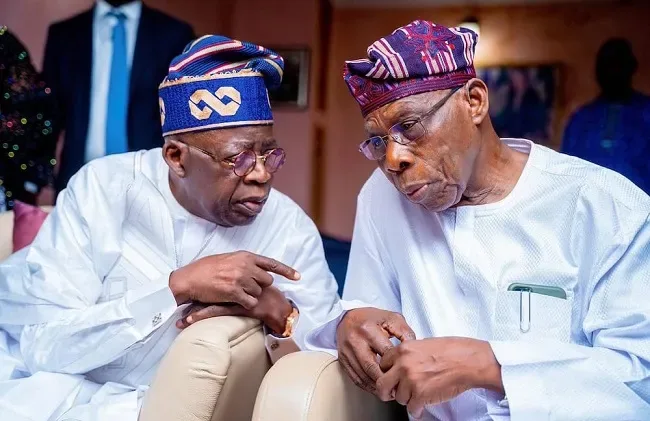
Former Nigerian President Olusegun Obasanjo has strongly criticized President Bola Ahmed Tinubu over his administration's borrowing policy, warning that excessive public debt could mortgage Nigeria's future and place an unbearable financial burden on generations yet unborn.
Speaking on Friday, October 30, 2026, at the Ajibosin Platform in Abeokuta, Ogun State, Obasanjo described debt as more dangerous than leprosy, rejecting Tinubu's earlier assertion that borrowing should not be viewed negatively.
Obasanjo declared:
"Debt is worse than leprosy. Because leprosy destroys only one person. Debt destroys generations."
His remarks came amid renewed national debate over Nigeria's rising public debt and the Federal Government's latest proposal to obtain additional foreign loans.
What triggered Obasanjo's criticism?
In April 2026, President Tinubu defended his administration's borrowing strategy, arguing that borrowing was not inherently harmful provided the government could generate sufficient resources to repay its obligations.
The President had stated:
"If we have to borrow, we borrow. Borrowing is not leprosy; we just have to work hard to be able to pay for it."
However, Obasanjo disagreed with this position, arguing that accumulating excessive debt could undermine economic stability and transfer financial responsibilities to future generations.
Tinubu's proposed $21.7 billion external borrowing
The controversy has intensified following Tinubu's request for National Assembly approval of a supplementary external borrowing plan covering 2026–2027.
The proposal includes:
- $20.52 billion in external borrowing.
- €1.045 billion in additional financing.
The proposed funds are intended to support infrastructure, agriculture, healthcare, education, water supply, security, employment generation and other development programmes.
Importantly, these figures represent a proposed borrowing plan awaiting legislative consideration, not necessarily money already disbursed to the government.
Obasanjo questions Nigeria's economic performance
Beyond borrowing, the former President questioned Nigeria's economic management, particularly the significant depreciation of the naira against the United States dollar.
Recalling his experience when he established his farm approximately 47 years ago, Obasanjo said the exchange rate was around ₦1 to $1.85.
He questioned how Nigeria moved from that historical exchange-rate position to approximately ₦1,500 per dollar, challenging successive political leaders to explain the country's economic trajectory.
He also questioned whether Nigeria's political leadership possessed the knowledge, competence and practical solutions required to address the country's economic challenges.
Criticism of the World Bank and IMF
Obasanjo further criticized Nigeria's dependence on international financial institutions, particularly the World Bank and the International Monetary Fund.
He argued that the economic policies promoted by these institutions might not adequately reflect Nigeria's unique circumstances and development priorities.
He also questioned why developing countries were discouraged from providing agricultural subsidies while farmers in developed economies continued to receive substantial government support.
According to him, Nigeria must critically examine external economic recommendations rather than blindly adopt policies that may not serve its national interests.
The bigger economic question facing Nigeria
Obasanjo's intervention raises an important question about Nigeria's borrowing strategy: how much debt can the country sustainably accumulate without compromising future economic stability?
Borrowing is not necessarily harmful. Governments worldwide obtain loans to finance infrastructure, industrial development and essential public services.
However, the effectiveness of borrowing depends on several factors:
- Transparency: Citizens must know how much the government borrows and where the money goes.
- Accountability: Public officials must be held responsible for the utilization of borrowed funds.
- Economic returns: Borrowed money should finance projects capable of generating economic value.
- Debt sustainability: Repayment obligations must not overwhelm government revenue.
- Public welfare: Infrastructure investments should translate into better living conditions, employment opportunities and improved access to essential services.
Ultimately, Nigeria's challenge is not simply whether to borrow, but whether borrowed resources are being converted into measurable economic benefits.
Note:
Editorial Perspective
The disagreement between Obasanjo and Tinubu highlights a fundamental issue in Nigeria's economic management: the relationship between borrowing, development and accountability.
While the Tinubu administration maintains that external borrowing is necessary to address infrastructure deficits and stimulate economic growth, Obasanjo warns that excessive debt could become a long-term burden on the country.
For ordinary Nigerians struggling with rising living costs, unemployment, inflation and declining purchasing power, the most important question remains whether these financial decisions will eventually improve their standard of living.
Nigeria needs more than ambitious borrowing plans. It needs transparent financial management, productive investments, responsible leadership and measurable results.
The ultimate test of government borrowing should be what it delivers to the people, not merely how much money is secured.
Sources for verification and accountability: