

News
Federal Government Begins Construction Of 2,000 Housing Units In Lagos Under Renewed Hope Programme
Development News
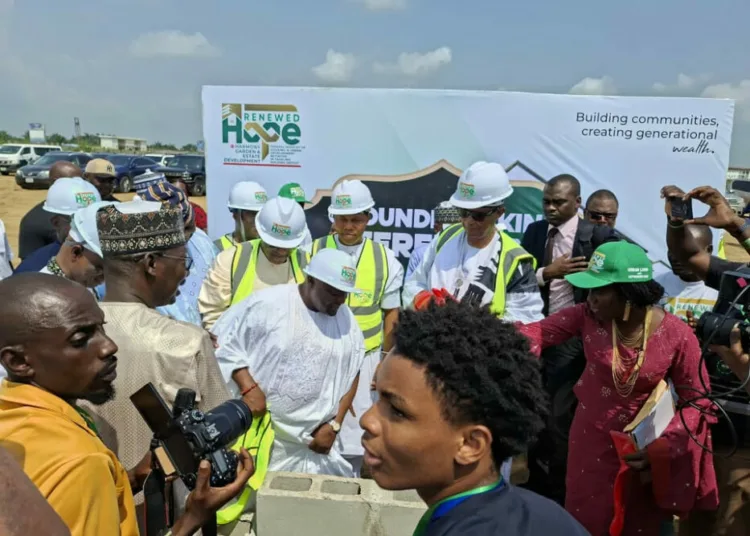
The Federal Government has commenced construction of 2,000 housing units in Lagos State under President Bola Tinubu's Renewed Hope Housing Programme, in a move aimed at addressing Nigeria's growing housing deficit and improving access to affordable homeownership.
The groundbreaking ceremony took place on Friday at Lekki Aviation Town, Ibeju-Lekki, Lagos, with the Minister of Housing and Urban Development, Muttaqha Rabe Darma, announcing the commencement of the project.
Key details of the housing project
According to the report by LEADERSHIP, the development will comprise two-bedroom and three-bedroom residential apartments.
The project is being implemented through a public-private partnership involving Harmony Gardens and Estate Development Limited and Metroscape Development Company Limited.
Its location in the Ibeju-Lekki economic corridor is considered strategic because of major economic investments in the area, including the Dangote Refinery, Lekki Deep Sea Port and the Lekki Free Trade Zone.
The government expects the development to increase housing supply, generate employment and support urban development.
Proposed payment arrangement
One of the major announcements concerns the proposed financing arrangement for prospective homeowners.
Abdullahi Saheed Mosadoluwa, Chief Executive Officer of Harmony Gardens, disclosed that interested Nigerians could reportedly access the scheme with an initial deposit of ₦100,000, while the outstanding balance would be spread over 25 years through the Federal Mortgage Bank of Nigeria.
The proposed arrangement is expected to accommodate categories of Nigerians including:
- Teachers and nurses.
- Police officers and civil servants.
- Young entrepreneurs.
- Nigerians living in the diaspora.
However, prospective applicants will need to establish the full eligibility requirements, repayment terms, interest rates and additional charges before making financial commitments.
Government promises mortgage reforms
Minister Darma acknowledged that increasing the number of available houses would not automatically resolve Nigeria's housing crisis.
He argued that access to affordable mortgage financing remains essential, particularly for low- and middle-income earners who cannot purchase properties through outright payments.
The ministry is also working towards harmonizing relevant housing agencies to improve coordination and access to mortgage facilities.
The minister further warned against poor construction standards, building collapses and professional misconduct, stressing that the project's success would depend on the timely delivery of quality and affordable homes.
Infrastructure and urban planning concerns
The House of Representatives Committee Chairman on Urban Development and Regional Planning, Awaji Inombek Abiante, urged the government and developers to ensure that the housing development incorporates proper urban planning.
He emphasised the importance of transportation networks, markets and essential infrastructure to prevent the emergence of poorly planned residential communities.
Factful24 Analysis: Will 2,000 Housing Units Make Homeownership Affordable?
Nigeria continues to face a significant housing affordability challenge, particularly in major urban centres such as Lagos, where rising property prices, expensive building materials, high rents and limited mortgage access have placed homeownership beyond the reach of many ordinary citizens.
The proposed 2,000-unit development represents a positive step towards expanding housing supply. However, the real test will be whether ordinary Nigerians can genuinely afford the completed properties.
The advertised ₦100,000 initial deposit may attract considerable interest, but the government and its development partners must provide transparent information about the actual cost of each property, monthly repayment obligations, interest rates, eligibility conditions and delivery timelines.
There is also the question of infrastructure. Housing developments must be supported by accessible roads, electricity, water, healthcare facilities, schools and public transportation.
Ultimately, Nigerians need more than groundbreaking ceremonies and housing announcements. They need completed homes that are affordable, accessible and supported by essential public infrastructure.
The central question remains: Will this programme deliver genuinely affordable homes for ordinary Nigerians, or will the benefits primarily reach middle- and high-income earners?
Source: LEADERSHIP – Federal Govt Begins Work On 2,000 Housing Units In Lagos.
Editorial note: The ₦100,000 deposit and 25-year repayment arrangement are statements attributed to the developer, not independently verified mortgage approval terms.