

Politics
Imo Political Crisis Deepens as Uzodimma and Okorocha Clash Over 2027 Senate Ticket, Rainbow Coalition
POLITICS | NIGERIA | NOVEMBER 1, 2026
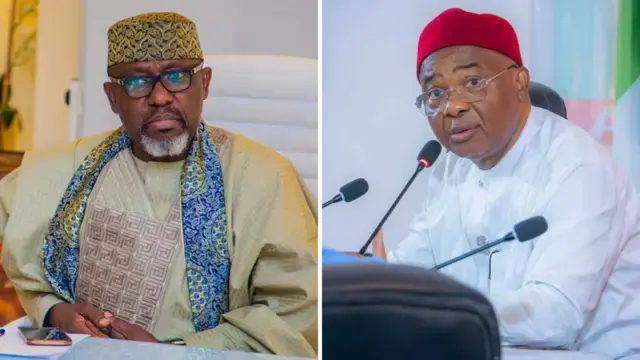
The political rivalry between Imo State Governor Hope Uzodimma and his predecessor, Senator Rochas Okorocha, has intensified following a Federal High Court judgment recognizing Okorocha as the All Progressives Congress (APC) candidate for Imo West Senatorial District in the 2027 general elections.
The dispute has exposed growing divisions within the ruling APC in Imo State and introduced fresh political complications through the emergence of the Rainbow Coalition championed by Federal Capital Territory (FCT) Minister, Nyesom Wike.
The disagreement is also attracting national attention because of its potential implications for President Bola Tinubu's re-election campaign and the political calculations surrounding the leadership of the next National Assembly.
Court Rules in Okorocha's Favour
The latest development followed a judgment delivered on October 29, 2026, by Justice Obiora Egwuatu of the Federal High Court in Abuja.
The court ordered the APC and the Independent National Electoral Commission (INEC) to recognize Okorocha as the party's candidate for Imo West Senatorial District in the 2027 elections.
According to the judgment, evidence presented before the court established that Okorocha won the APC senatorial primary conducted on May 18, 2026.
The ruling directed the party to forward his name to INEC, effectively challenging the earlier recognition of Uzodimma as the party's candidate.
The controversy stems from conflicting accounts of the primary election results.
The APC's declared results showed Uzodimma winning with 230,464 votes against Okorocha's 1,098 votes. However, Okorocha challenged the figures, arguing that the results submitted to INEC did not reflect the actual outcome of the exercise monitored by the electoral commission.
Uzodimma's Camp Rejects the Judgment
The Imo State chapter of the APC has rejected the court ruling, insisting that Uzodimma remains its legitimate candidate for the senatorial district.
The party's position was communicated through a statement signed by State Chairman Austin Onyedebelu and Publicity Secretary Onwuasoanya FCC Jones.
The leadership questioned the court's assessment of the evidence and said its legal department was studying the Certified True Copy of the judgment to determine the next course of action, including a possible appeal.
The APC also appealed for calm among supporters across the 12 local government areas of Orlu Zone while the legal process continues.
Okorocha Embraces Wike's Rainbow Coalition
Beyond the court battle, Okorocha's declaration of support for the Rainbow Coalition has introduced another dimension to the political confrontation.
Speaking on Channels Television's Politics Today on October 29, the former governor commended Wike's political mobilisation strategy and announced plans to establish a similar coalition in Imo State.
The initiative seeks to bring together politicians from different political parties, including the Peoples Democratic Party (PDP), to support Tinubu's second-term ambition.
Okorocha questioned Uzodimma's political influence in Imo State and the wider Southeast, arguing that the governor could not independently guarantee electoral victory for Tinubu in the region.
He declared that his return to the ballot would strengthen the President's electoral prospects in Imo State.
His comments represent a significant political challenge to Uzodimma's position as the APC's leading political figure in the state.
Uzodimma Opposes Coalition Outside APC Structure
Uzodimma has maintained a different position on the Rainbow Coalition.
On October 27, the governor declared that there was no Rainbow Coalition in Imo State, insisting that political mobilisation for Tinubu's re-election should operate through the APC.
He reportedly warned members of the PBAT Door-to-Door Movement against participating in political activities outside the ruling party's structure.
The governor also threatened to withdraw campaign vehicles provided to members of the movement if they engaged in activities outside the APC framework.
Wike, however, has maintained that the Rainbow Coalition is designed to mobilize support for Tinubu across party lines without requiring participants to leave their respective political parties.
The disagreement illustrates the growing tension between the traditional party structure and broader political alliances ahead of the 2027 elections.
PDP Sees Opportunity in Imo Political Crisis
The PDP has also entered the unfolding political debate.
The party's National Secretary, Senator Samuel Nnaemeka Anyanwu, described the Rainbow Coalition as a potential platform for challenging the APC's political dominance in Imo State during the 2027 elections.
Through a statement issued by his media adviser, Ikenna Onuoha, Anyanwu criticized the Uzodimma administration over alleged shortcomings in infrastructure, healthcare, education and the state economy.
He also cited the reported industrial action involving lecturers at Imo State University as an example of issues requiring government attention.
Anyanwu argued that opposition parties could use the emerging coalition to mobilize voters and challenge the APC in the state.
These remain political allegations by the PDP official and have not been independently established by the report.
Senate Presidency Ambition Adds to the Controversy
The dispute over the Imo West ticket also has implications beyond the immediate senatorial contest.
Uzodimma's reported ambition to become Senate President in the 11th National Assembly has become part of the political calculations surrounding the disagreement.
The Renewed Hope Foot Soldiers for Tinubu, led by National President Gbenga Owojori, warned that the crisis could undermine APC unity in the Southeast and complicate Tinubu's second-term campaign.
The group argued that Uzodimma should be allowed to pursue his political ambitions through transparent and established procedures.
It also raised allegations concerning possible political interests involving Senate President Godswill Akpabio and Wike. However, it provided no evidence establishing that either individual influenced the court proceedings.
The group called on APC leaders to resolve the dispute through transparent processes and inclusive dialogue.
LEADERSHIP Newspapers+1
What Happens Next?
The APC's possible appeal could prolong the dispute over who ultimately represents the party in Imo West.
The controversy also raises questions about the relationship between party primaries, judicial intervention and the constitutional eligibility of serving public officials seeking other elective positions.
Okorocha has questioned Uzodimma's eligibility under Section 183 of the 1999 Constitution, which restricts a sitting governor from holding another executive office or paid employment while in office.
The legal implications and any final determination will depend on the applicable constitutional provisions and subsequent judicial proceedings.
For now, the political confrontation remains unresolved.
Political Implications for Nigeria's 2027 Elections
1. APC unity in the Southeast
The dispute could deepen divisions within the ruling party and weaken its ability to coordinate political mobilization across the region.
2. Tinubu's re-election strategy
Okorocha's willingness to mobilize politicians across party lines could strengthen the President's political network, but disagreements over coalition leadership could undermine that objective.
3. Wike's growing political influence
The Rainbow Coalition provides Wike with another platform for influencing political alignments beyond the traditional boundaries of the PDP and APC.
4. The future of Imo politics
The confrontation could reshape political alliances in Imo State, particularly as politicians position themselves ahead of the 2027 elections.
5. Senate leadership calculations
The outcome of the senatorial dispute could affect the political ambitions of influential figures seeking leadership positions in the next National Assembly.
Editorial Takeaway
The confrontation between Hope Uzodimma and Rochas Okorocha is no longer simply a disagreement over an APC senatorial ticket. It has evolved into a broader struggle involving party control, political influence, coalition building and the future distribution of power ahead of Nigeria's 2027 general elections.
For President Tinubu, the situation presents a political dilemma: how to maintain unity among influential allies while accommodating competing ambitions within the ruling party and its emerging cross-party support network.
The Rainbow Coalition may expand the President's political reach, but its effectiveness will depend on whether its supporters can manage competing interests without creating deeper divisions.
The bigger question is whether the APC can resolve its internal disagreements before they become a major electoral liability in the Southeast.