

Health & WellBeing
Abuja Cancer Awareness Walk Highlights Urgent Need for Early Detection and Affordable Treatment
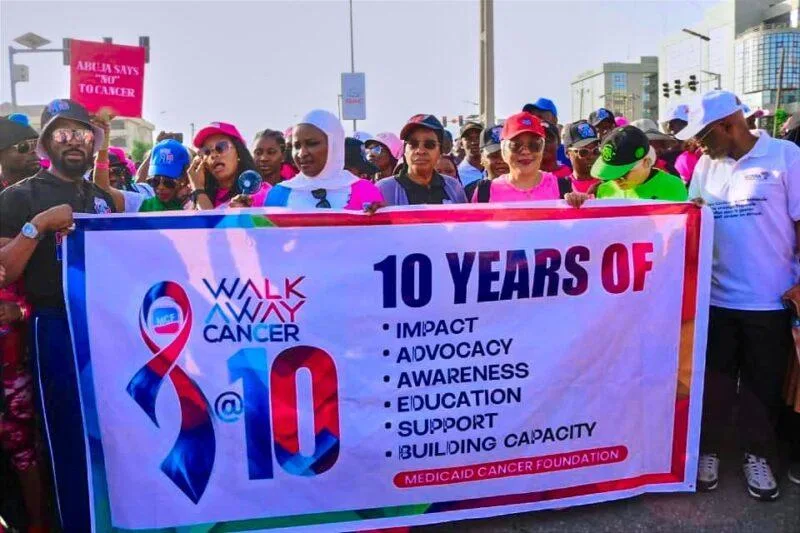
Cancer survivors, health professionals and government officials have called on Nigerians to embrace regular screening and preventive healthcare as the 12th edition of the Walk Away Cancer campaign draws attention to the country's growing cancer burden.
Cancer awareness advocates, survivors, policymakers and residents have renewed calls for improved cancer prevention, early diagnosis and affordable treatment following a major awareness walk in Abuja.
The event, organised by the Medicaid Cancer Foundation (MCF), took place on Saturday, October 31, under the theme “One Walk, One Fight – Walk Away Cancer.”
The 12th edition of the annual campaign attracted participants to Monoliza Park in Area 11, Garki, Abuja, as part of activities marking the conclusion of Breast Cancer Awareness Month, popularly known as Pink October.
Led by Dr Zainab Shinkafi-Bagudu, founder of the Medicaid Cancer Foundation and President of the Union for International Cancer Control (UICC), the campaign featured survivor testimonies, public health education and free medical screening services.
Free Medical Screening and HPV Vaccination
One of the major attractions was the Health Village, where participants accessed several free health services, including:
- Clinical breast examinations.
- Blood pressure and blood sugar checks.
- Hepatitis testing.
- Eye screening.
- Access to discounted digital mammography screening.
- HPV vaccination for eligible young girls.
The activities were designed to encourage Nigerians to take preventive healthcare seriously and seek medical attention before illnesses become advanced.
The organisers also emphasized that early diagnosis can significantly improve treatment outcomes and survival prospects.
Government Raises Cancer Funding Questions
The Minister of Budget and Economic Planning, Abubakar Atiku Bagudu, disclosed that the Federal Government had invested more than ₦1 trillion in cancer control interventions over the preceding year.
According to the minister, approximately ₦350 billion had been committed to establishing cancer centers, while more than ₦300 billion had gone towards procuring cancer detection equipment.
He also said additional resources had been made available to state and local governments to support cancer prevention, early detection and treatment.
However, Bagudu stressed the importance of accountability, urging Nigerians to monitor how governments at the subnational level utilise funds allocated for cancer control.
The disclosure raises an important question about the effectiveness of public health spending: how much of the announced investment is translating into accessible screening, diagnosis and treatment for ordinary Nigerians?
Cancer Survivors Urge Nigerians Not to Ignore Screening
A particularly powerful contribution came from cancer survivor Farooq Oreagba, who disclosed that he had lived with an incurable cancer diagnosis for more than 12 years.
He attributed his survival to early screening and detection, encouraging Nigerians not to wait until they experience severe symptoms before seeking medical attention.
His testimony reinforced the campaign's central message that a cancer diagnosis should not automatically be regarded as a death sentence.
The President of the Cancer Society of Nigeria, Professor Abidemi Omonisi, also called on government institutions, civil society organizations and individuals to increase support for cancer patients and survivors.
Meanwhile, Dr Shinkafi-Bagudu called for stronger government financial commitments to cancer prevention, diagnosis and treatment.
The Bigger Challenge: Making Cancer Care Affordable
Despite increased public awareness and government funding announcements, the cost of cancer diagnosis and treatment remains a major challenge for many Nigerian families.
Limited access to specialised facilities, delayed diagnosis, financial difficulties and inadequate public awareness can prevent patients from receiving timely medical attention.
For many households, the financial burden extends beyond medical bills to transportation, accommodation, medication and prolonged treatment.
The Abuja campaign therefore highlights the need to translate awareness initiatives and government investments into affordable, accessible and sustainable healthcare services.
Note:
Cancer prevention cannot depend on annual awareness campaigns alone. Nigerians need accessible screening facilities, affordable treatment, reliable diagnostic equipment and stronger patient-support programmes.
The Federal Government's reported investment of more than ₦1 trillion in cancer control also makes transparency and accountability essential.
Ultimately, the success of Nigeria's cancer-control strategy should be measured not simply by the amount of money announced or the number of awareness walks organized, but by how many lives are protected through early diagnosis, timely treatment and improved access to healthcare.
Editorial note: The ₦1 trillion figure is attributed to the Minister of Budget and Economic Planning. It should be understood as a government-reported investment claim, not an independently audited expenditure figure.
Sources and verification
- LEADERSHIP – Abuja Walk Raises Awareness on Cancer Prevention, Early Detection.
- The Guardian – Experts, Residents Walk Against Cancer.
- Punch – Ministers Urge Nigerians to Embrace Early Cancer Screening.
- THISDAY – Stakeholders Sensitise FCT Residents on Early Cancer Detection.
- Kapital FM – FG Invests Over ₦1 Trillion in Cancer Control.